
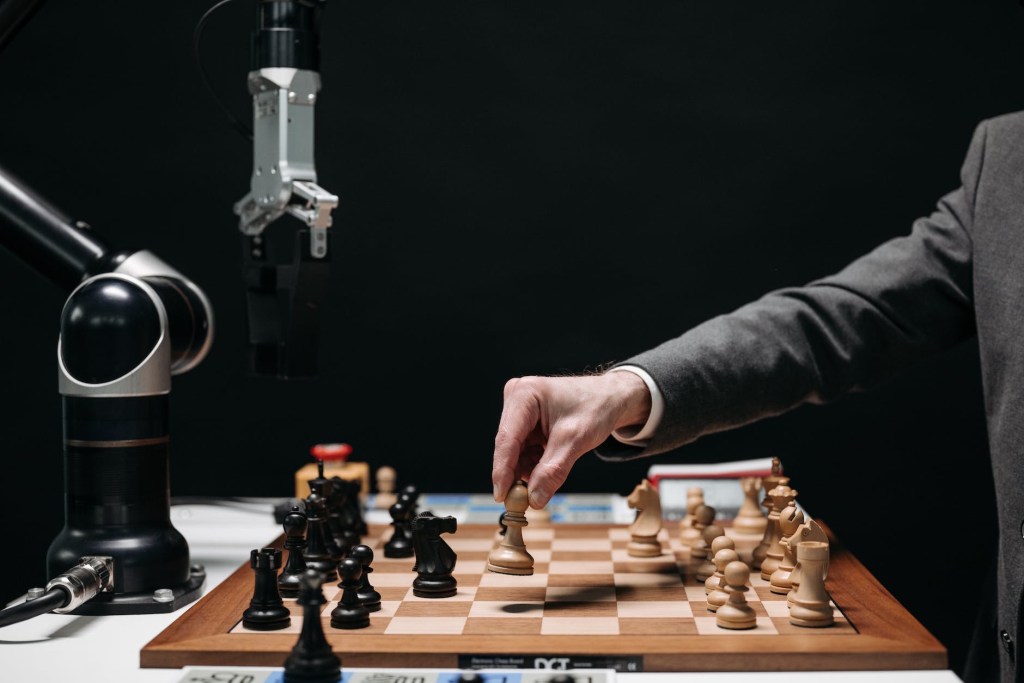
From what I have been reading in the news recently, my reviews might soon be written by AI. Erewhon, by Samuel Butler published anonymously in 1872, contains one of the earliest explorations in literature of artificial intelligence. I thought it was time to take a look.
The opening chapters introduce us to Higgs, the book’s narrator, who works at a sheep station in an unnamed British colony. Butler based this section on his own experiences in New Zealand, where he fled to escape his overbearing, religious family. Just like Butler, Higgs goes on an expedition to explore uncharted areas.
After a perilous journey across a mountain range, Higgs finds himself in the country of Erewhon, which is an odd, distorted, mirror image of his own society. Erewhon criminalises physical illness while moral lapses receive compassion and medical assistance. There is an odd banking system where people deposit money in an effort to build up a kind of spiritual capital. A literal-minded religion teaches antipathy to machines. All of these topics cause Higgs to question conventional ways of thinking.
And this is where the famous section on machines and artificial intelligence comes in. Higgs finds The Book of the Machines, a set of documents describing a crisis thousands of years previously, when rapid technological evolution led to fears that machines would eventually enslave, or supersede, humanity. Reading The Book of the Machines, Higgs’ conventional assumptions come in for a pummelling. Machines are not considered as living, sentient things, but where does the dividing line exist? Is a leg a machine that life uses to get about? Or is a leg itself life? Plant life is not generally considered sentient, but it would be hard to say plants are not alive. Plants act to protect themselves and communicate with each other. Machines also protect themselves and communicate with each other. They need outside help to reproduce, but so do plants, which employ the services of bees. So are machines similar to plant life? And if we worry about becoming slaves to machines, what is the nature of the relationship that already exists? Even in the nineteenth century people were serving machines in a slavish capacity. A stoker on a ship spent backbreaking days feeding and tending a machine that relies on people for its continued existence. Equally, people rely on the labour of machines. The present population of the world could not be supported without them.
So coming back to where I started, does this book make me feel any better about the prospect of AI writing my reviews? Well, first I have to say that Erewhon is remarkable, coming out of strait-laced Victorian society, throwing over conventional thinking so completely that it remains challenging and thought provoking hundreds of years later. As for what the book has to say about artificial intelligence, you might end up agreeing with the Erewhonians who decide that it is safer to get rid of machines, given how they might develop. However, there is much to suggest this is not sensible The relationship between people and machines is as old as humanity itself. In fact, use of tools, which evolved into machines, might actually be the defining characteristic of humankind. People and machines are mutually dependent. Rather than seeing a threat to humanity from machines, you could say that, for better or worse, humans without machines are not really themselves.
 Writing And So On
Just ordered this book. Probably got put on a list for it, lol. Excited for this read! Gonna be my first (by choice) in quite a while.
LikeLike
Thanks for commenting. Really hope you enjoy it.
LikeLike