Science fiction often works by taking dangerous potentials lurking in current trends and then magnifying them out into a possible future. A lot of famous mid-twentieth century science fiction – Brave New World, Nineteen Eight-Four, Fahrenheit 451, imagined what would happen if government gained excessive power over people’s lives. Maybe by the 1990s some were taking this message rather too seriously. 1990s America saw a strengthening of sentiment hostile to government. Conservative groups, such as the ‘Citizens for Sound Economy’ stated an aim for smaller government and less regulation. Then came the Tea Party of the 2010s, and the Republican Party of the 2020s, parts of which appeared to want not just smaller government, but no state institutions at all. Interestingly, the world of 1992’s Snow Crash, by Neal Stephenson, imagines the consequences of these people getting their way. With organised crime stepping into the power vacuum, it’s not a pretty picture. The rich live in gated communities, the poor in ghettos. The police are a private enterprise protecting those best able to pay. And of course, the cruelly ironic effect of ‘freeing’ yourself from stabilising institutions, is an increased risk of some deranged individual coming along and imposing a personal dictatorship. And this is where Snow Crash’s magnified threat comes in. Maybe the threat we face isn’t where the old sci fi thought it would be. Snow Crash might be closer.
When he lost his job as an oil company executive, Raymond Chandler found himself unemployed during the years of the Great Depression. Thrown back on an early interest in writing, he decided that crime fiction might pay the bills. In a business-like way he taught himself the genre’s formula by reading pulp magazines and the work of Erle Stanley Gardner, creator of Perry Mason. The Big Sleep, published in 1939, was Chandler’s first novel.
Looking back on his career, in his book Trouble is My Business, Chandler reminisced about trying to escape the limits of his chosen genre. While crime appeared to be his only option from a financial point of view – feeling ill-equipped to write romance for women’s magazines – he decided to join those who stretched the formula by writing stories where solving a mystery was not really the point. For Chandler, the perfect detective story ‘was one you would read if the end were missing’. Scene should outrank plot.
That was how I enjoyed The Big Sleep. The plot, involving a wealthy, grievously ill man, his wayward daughters and a blackmail attempt, is fairly confusing. I preferred to follow private detective Philip Marlowe, going about his work in long, lugubrious scenes, through rainy nights in 1930s Los Angeles. Marlowe’s character provides the interest. He is a detective living in a society of murky morals, where, for example, changing attitudes to Prohibition make the drinks business an illegal enterprise one day, a legitimate business the next. Certainties are hard to find. Marlowe responds by shrinking his personal world down to a small flat, and his work. And that’s it. From this little fortress he looks out at life, just as Raymond Chandler himself looks out from the tight confines of crime fiction. In a dark way, it’s almost cosy, in the sense that we have settled into our small corner, appreciating its limits even in resenting them.
For all the compulsive effort Marlowe puts into his work, even dreaming about it at night, he never gets a pay off, either financially or emotionally, at the end of it. In fact, there never really is an end. As he says to his client: ‘when you hire a boy in my line of work, it isn’t like hiring a window washer and showing him eight windows, and saying, “Wash those and you’re through”’.
There are, however, some dark consolations to be found in never reaching a satisfactory conclusion. When you are reading for scene rather than plot, the story’s point is not a few moments right at the end when the mystery is solved and justice apparently done. The point of the story is the whole thing, the long, atmospheric scenes which can be enjoyed in a leisurely way as Marlowe wanders through Hollywood fog. The journey becomes its own destination. I really enjoyed The Big Sleep in that respect. The term Big Sleep is a euphemism for death, the end of all our journeys. In that case it is definitely best to focus on scene rather than plot. Plot will provide a few moments of satisfaction: scene can last a lifetime.
In November 2023, The Beatles released their last song, Now and Then, with front cover art by American artist, Edward Rushcha.
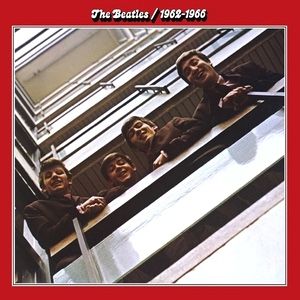
Observant fans have drawn comparisons between the Red and Blue compilation album covers and the Now and Then cover, in the sense that they all feature diagonal lines. Is that just a coincidence? Or does this type of line have a role to play in producing an interesting and fitting image?
Let’s start with those Red and Blue album covers. The Beatles are pictured on the internal stairway at EMI House in 1963 and 1969. The stairwell balconies create a set of diagonals. These images could have been presented face on, but photographer Angus McBean tipped everything sideways. In photography or art, horizontal and vertical lines naturally suggest stability and structure. Diagonals, by contrast, bring a sense of dynamism, excitement, instability or insecurity. In the words of Cornell academic Charlotte Jirousek, an object on a diagonal line is always unstable in relation to gravity. The Red and Blue era Beatles appear happy enough, but the angled balconies imply something like a sinking ship. The exciting and terrifying experience of being world famous, while creating music of turbulent reinvention, certainly must have been ‘unstable in relation to gravity’.
Now and Then has been billed as the last Beatles song, but lyrically it’s really about continuing emotional uncertainty, and does not suggest an end. The cover reflects this. Apart from the diagonals, the image is ambivalent in how solid it appears to be. The background colouration could be seen either as a flat plain, on which the diagonals sit as folds, or as a gauzy, misty, watery surface with depths beyond. We have not reached firm ground. Everything is still slipping and sliding, and we cannot be sure of our footing. In fact Rushcha’s cover makes me think of words associated – accurately or otherwise – with John Lennon: ‘It’ll be alright in the end, and if it’s not alright, it’s not the end.”
(Images courtesy of Wikipedia Commons)
Post script
Post script
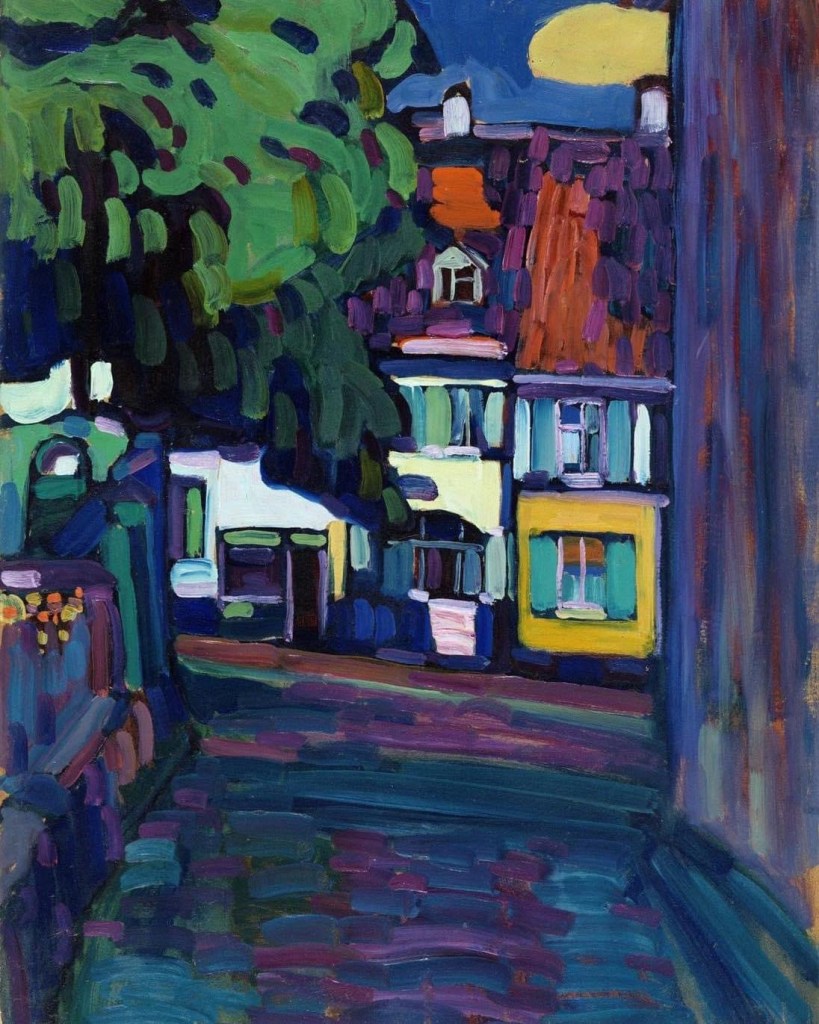
I follow various art institutions on Facebook. Here are pictures posted to my feed in the few weeks after writing this article. It is an arbitrary selection, but just look at all the diagonals…
Houses in Murnau on Obermarkt by Wassily Kandinsky Le Bistro by Edward HopperManson Maria with a View of Chateau Noir by Paul CezanneRoad at St Paul by Felix VallottonFarm at Montfoucault by Camille Pissarro Kiental mit Bluemlisalp by Eduard Boss




 Writing And So On