Still Life is a novel by Sarah Winman, published in 2021.
Ulysses, is a young soldier in the British Army during World War Two. Like Homer’s Ulysses, we first meet this man fighting battles in the Mediterranean. The parallels continue as Ulysses returns home to London in 1945, to find that Peg, the wife he left behind has a few suitors – Col a publican, Cress who works in Col’s pub, and an American soldier called Eddie. At this point Still Life and The Odyssey diverge. While Homer’s Ulysses engages in vengeful killing of suitors, Col and Cress remain good friends with Ulysses, and with Peg. Peg has Eddie’s baby while Eddie himself never returns from the war. Ulysses helps bring up Peg’s little girl.
Also we don’t actually get the feeling that Ulysses has reached home in returning to London. When he is left money and property in Florence by an Italian man whose life he saved during the war, he decides to make his home in the place where he fought. Cress and the little girl go with him. In Odyssey terms it would be as if Ulysses teamed up with one of the suitors, while adopting the child of another, and went off to live in Troy.
Interesting.
I think the point has something to do with not being too fixed in how we see life. Still Life portrays life as something that isn’t still. Home is not a definite place making all other places foreign. You might dream of reaching home, but then home might end up in the faraway land where you fought your war. The narrative is structured in a way that jumps around in place and time, as if neither of these things are entirely stable.
Following a time of war where friends, enemies, home, foreign fields are all starkly separate, we learn perhaps that letting go of these fixed concepts might be a way to find peace and forgiveness. There is no need for vengeance on suitors, or foreigners. Foreigners can be your family, as Ulysses discovers in his new life in Florence. Suitors and husbands can be friends. Hope for the future can be a return to the past.
This was a fascinating twist on the Odyssey story. Thinking in terms of the Odyssey, a parrot character called Claude, who not only mimics human speech, but offers opinions and apposite Shakespeare quotes, kind of makes sense, as do the sentient trees that pop up occasionally. These are the equivalent of Homer’s deities.
At times I did find the writing a bit overly sentimental. However, the book held itself together with some great ideas, and I ended up enjoying and admiring it.
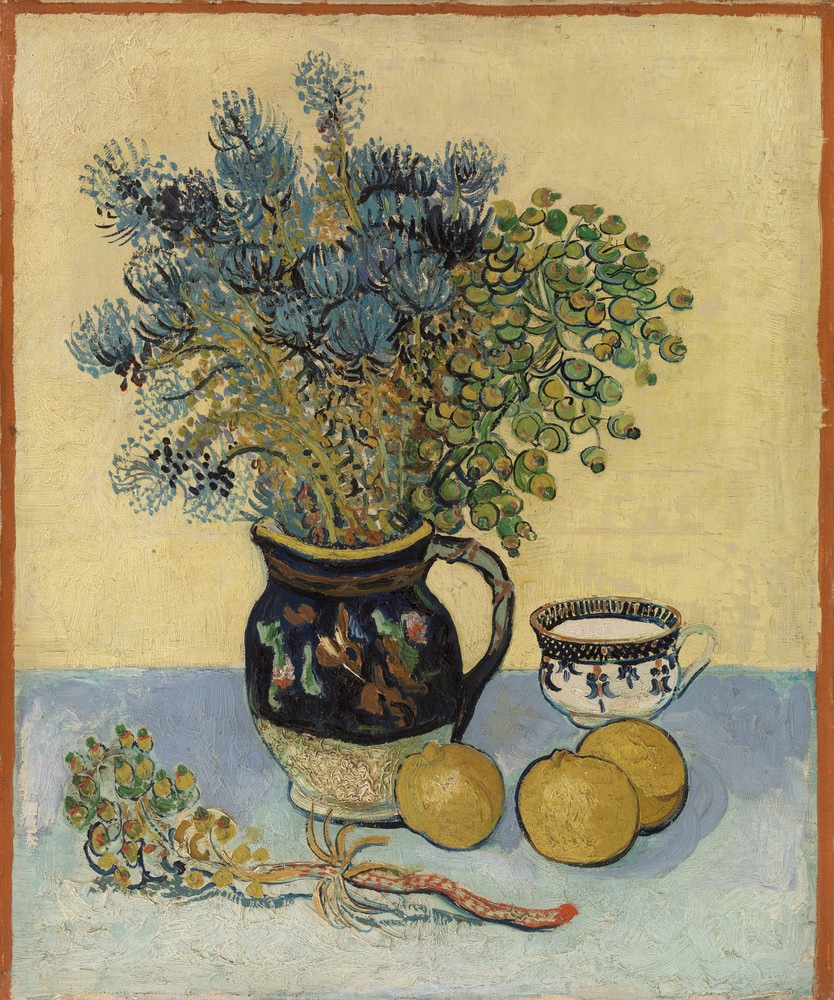
And finally, why did I choose a Van Gogh still life to illustrate this article. Because I particularly like this painting. I like the way it is a typical still life kitchen scene with jug, cup and some lemons. But the jug contains a profusion of flowers instead of milk. The lemons seem soft and shapeless as if they are on the turn. A sprig has either fallen out of the packed flower display, or is waiting to be included in the arrangement. There is a great deal of movement in this still life. It displays beautiful flowers in what we might think of as a utilitarian container not apparently meant for flowers. I thought this fitting for Sarah Winman’s book.

 Writing And So On