I have just caught up with 2023’s Barbie, a film where there are lots of different Barbies, all called Barbie, and lots of different Kens, all called Ken.
After having a bit of an existential crisis during a dance routine, Stereotypical Barbie leaves Barbieland with Beach Ken, who jumps uninvited into the back of her pink convertible. They head to real Los Angeles, where Ken discovers the patriarchy. He takes this back to Barbieland, where he sets up his own version, important elements of which are riding horses and dressing up like a rock star. The Barbies respond by turning the Kens against each other. They do this by offending the Kens’ egos during their beach serenading of the Barbies with Matchbox Twenty’s song, Push. Barbies listen for a while before moving to another Ken, causing devastating jealousy.
Following this debacle, there is a touching scene as Beach Ken and Stereotypical Barbie talk, Barbie telling Ken that he needs to find his own identity, beyond that of her boyfriend, or some kind of ridiculous bro. And that’s the thing – the unexpected philosophical twist of this charming film. Ken, in all of his incarnations, is Ken. After the beach serenading scene, when the Kens decide to fight each other, they have to decide which Kens are the enemy, and which are allies, a tricky task when they are all Kens. So maybe Ken would learn something by accepting that there is sameness in his variety. Ken’s jealousy is like one branch of a tree having a problem with another branch. Note the wall being built in the desert between Barbieland and the real world. What does that make you think of in the early 2020s? What does that suggest about creating division between people where none need exist?
So Barbie is about both finding identity and overcoming identity’s false limitations. Barbie can be President Barbie or housewife Barbie, black or white, different shapes and sizes Barbie, but she shares in the essential Barbieness. And Ken can be all sorts of Ken, but he can share in the essential Kenness. In the end Ken and Barbie can be themselves, but be with each other.
Gone with the Wind by Margaret Mitchell was published in 1936. Wikipedia tells me that a Harris poll in 2014 found it to be America’s second favourite book, behind the Bible. When I did English with American literature at university, Gone with the Wind wasn’t included on any reading list. All these years later it was with some trepidation that I downloaded a Kindle copy. A bit of initial review reading had revealed accusations of racism in some quarters. Was this book the equivalent of a gun? Guns are popular in America, but that doesn’t necessarily mean it’s a good idea for me to buy one.
Nevertheless, I started reading, finding myself in Georgia in 1861, where huge fortunes are made growing the valuable commodity of cotton using cheap slave labour. The resulting society is one of extremes, wealthy and poor, coarse and refined. Those at the top show off their money with fancy clothes, big houses, or perhaps by cultivating the image of gentlemanly intellectualism. Parallels between wearing fancy dresses at extravagant parties, and sitting around reading Shakespeare, immediately give a feel for what will become a major preoccupation of the book – the nature of value. If this book were racist, for example, one lot of people would be portrayed as better and more valuable than another. Does it do that?
This is a long book and there are so many examples you could reference. But from the early part of the story, showing the South at its decadent height, there are unexpected parallels between the role of slaves and pampered white women. Mammy the black nanny is stuck between plantation matriarch Ellen on the one hand, and Ellen’s head-strong, teenage daughter Scarlett on the other. Mammy has to carry out Ellen’s instructions with regard to Scarlett, even when Scarlett doesn’t want to do as instructed. Theoretically Mammy would be expected to obey both conflicting sets of demands. Considerable guile is necessary to navigate this treacherous situation. Then there’s Jeems, a servant to the Tarleton twins – not allowed to listen in on white conversation, unless his masters tell him that’s what they want him to do. The rules of good behaviour keep changing. And interestingly this is the same for privileged women. For a respectable young woman, winning a husband means cultivating the image of a meek airhead, which is only relevant until the woman is married, after which she is expected to became a competent estate personnel manager looking after a combined household and business perhaps involving hundreds of people, all the while making it look like the husband is in charge. Women and slaves have to balance one set of demands against a totally opposing set.
This all takes on another dimension when war is declared over the issue of slavery, between the northern Union and the Confederacy of southern slave owning states. The Confederacy, deluded in believing its agricultural wealth can challenge the industrial power of the North, suffers a terrible series of defeats, throwing it into a kind of post apocalyptic scenario worthy of Margaret Atwood. What do bonnets or books mean when you haven’t got enough to eat? People and values swap places, as the world tips on its head. Former strengths are now weaknesses and vice versa. Scarlett, bewails the end of slavery, but doesn’t seem to mind that in the confusion she has more freedom to throw off the shackles that weigh her down as a woman. She becomes a mill owner and entrepreneur, something that would have been unthinkable before the war. She manages, at least partially, to escape social rules that are as harsh as anything found anywhere in the world. Following the death of her first husband early in the war, exuberant Scarlett is expected to effectively end her life, spending what remains in mourning. Her admirer Rhett Butler tells her about the former Indian practice of suttee, practiced among high caste women:
‘In India, when a man dies he is burned, instead of buried, and his wife always climbs on the funeral pyre and is burned with him.’ ‘How dreadful! Why do they do it? Don’t the police do anything about it?’ ‘Of course not. A wife who didn’t burn herself would be a social outcast. All the worthy Hindu matrons would talk about her for not behaving as a well-bred lady should—precisely as those worthy matrons in the corner would talk about you, should you appear tonight in a red dress and lead a reel. Personally, I think suttee much more merciful than our charming Southern custom of burying widows alive.’
Racism demands that one set of people is valued above another. That is just not the case here. If Gone With The Wind were a gun used to shoot someone, it could just as easily become a weapon that turns on the person who wields it.
So did I miss out when my American literature course passed over Margaret Mitchell? If her book was nonfiction it would no doubt be misleading. I mean, Rhett’s quote about suttee makes out this is a common practice in India when it’s a tradition almost entirely consigned to the past. But then no account of history is perfect. And besides that, Gone with the Wind is a novel, a fictional form, the best examples of which explore the fictions people deal in. And this novel both projects and undermines a smug, distorted image of closed-minded exceptionalism. Shakespeare is mentioned a number of times, and a play like Henry V, seemingly jingoistic, also subversive, does something similar. These are works of literature helping us to understand strange, interesting, often brutally self-centred societies, and also helping us understand people in general.
The book ends with those famous words, ‘tomorrow is another day’. This is the sort of book I will continue to think about, and people will continue to argue about. Tomorrow I might give it one star. Today, however, I’ll give it five.
Lucky Jim is a novel by Kingsley Amis, published in 1954. It tells the story of young Jim Nixon, who is in his probationary year as a lecturer in medieval history at an unnamed provincial university. He loathes the pretensions of his colleagues, and wages a vendetta against the son of his boss, a second rate artist with first rate belief in his own genius.
And yet while those colleagues and egotistical artists are useless fakes, so too is Jim. He seems to hate his subject, only taking medieval history because it had been the soft option when he was studying for his own degree. He doesn’t like teaching, ignores the one conscientious student the university seems to posses, while favouring prettier, less able ones. He bluffs his way along with the rest of the staff, living in mortal fear of losing his detested job.
Meanwhile in his personal life he is in an uneasy relationship with Margaret, an emotionally volatile fellow academic, who seemingly tried to commit suicide following a previous failed relationship. Jim feels compelled to continue with her even after meeting another girl with whom he seems much happier.
These personal and professional tensions all lead up to a chaotic climax at a lecture Jim is obliged to give on the theme of Merrie England. He is expected to extoll the lost virtues of a society engaging in summer morris dancing and winter mummers’ plays.
I suppose, getting to the end, I was asked to accept that there was a difference between Jim’s fakery and the fakery he was surrounded by. While Jim was an honest faker, the other staff were of the dishonest variety, especially it turns out, Margaret – I will leave you to discover the details there. So then I had to ask myself, is it possible to have this sort of distinction between good and bad fraud? I then wondered, thinking of the bigger picture, if we are perhaps being asked to accept that novels are themselves a kind of honest sham? After all, Lucky Jim is rather self-consciously a novel, in the sense of having novel-like things in it, such as an enemies to lovers scenario, and proving your love by racing to catch someone before they board a train at a station. Can you get more truth from this sort of thing than say, an academic paper on fifteenth century ship building? Maybe life is, and always has been something of a swindle. There was no age of innocence, no Merrie England. And there is no place of innocence. Universities are not some sanctuary offering the truth and fairness lacking in the rest of society. A university is just another work place dominated by favouritism, internal politics and saying what the boss wants to hear.
Maybe the fakery of a novel is the best way to get to the truth of such a situation. Maybe in the end Jim is lucky to be a character in a pretend novel rather than an academic at a real university.
Revolutionary Road was Richard Yates’ first novel, published in 1961. It tells the story of Frank and April Wheeler, who live a typical suburban life in 1950s America. They seem to have been sucked into a vacuous sort of existence, which they dream of escaping by moving to Paris.
So is this book a satire on 1950s American values? Well I wasn’t sure. There are plenty of references to boring working lives in the service of buying houses and ice-cream coloured cars. On the other hand there are some personal decisions going on here too. When Frank leaves university he chooses to take a boring, undemanding job in a business equipment firm, because that would leave him free to concentrate his attention on other more important work in his spare time. The thing is he never gets round to the painting, sculpture, composing, or writing to which his spare time was meant to be devoted. Does Frank blame society for a sort of personal laziness?
Revolutionary Road isn’t just a satire on 1950s American values, with America empty and materialistic while Paris represents some unachieved creative nirvana. In America or Paris, you just have to get on with some creative stuff. Maybe Frank Wheeler is the book’s author Richard Yates, if Richard hadn’t knuckled down in his home office and got on with his writing. In a way this bleak book offers grudging encouragement. You are where you are, and wherever that is offers an opportunity at fulfilment. You too can create a beautifully written, compelling, complex book like Revolutionary Road. That’s what I took from it, before getting on with some editing.
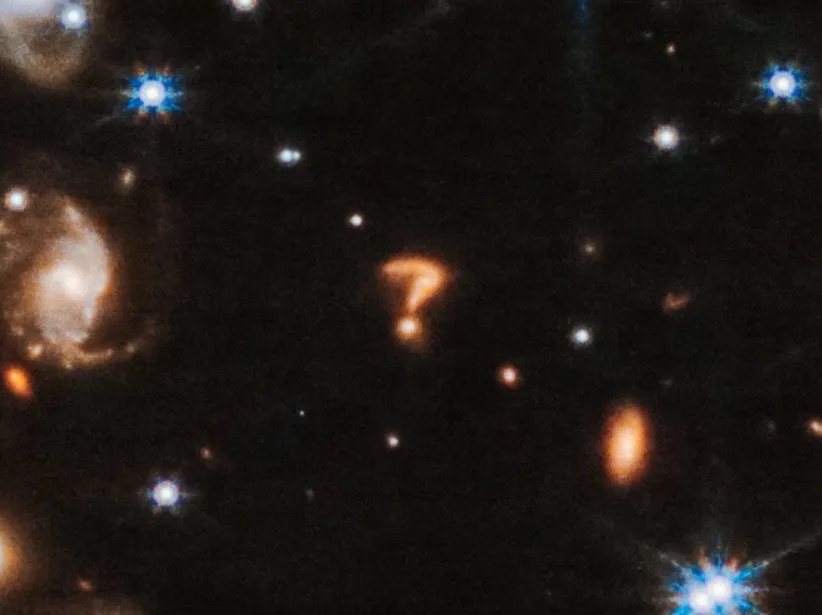
The ‘cosmic question mark’ in an image taken by the James Webb Telescope
Enlightenment by Sarah Perry is a Booker Prize nominated novel published in 2024.
Thomas Hart, a journalist on a local newspaper in Essex, becomes fascinated by astronomy after his editor asks him to write a column on the subject. With a museum official, he investigates a nineteenth century woman, a past resident of a nearby country house, who may have been a keen amateur astronomer, and unacknowledged discoverer of a comet. The story follows Thomas’s investigations, and his attempts to accommodate religious feelings with both his scientific interests and the austere church he attends, which obliges him to hide the fact that he is gay.
This book is much concerned with making it appear that science and religion are not at odds in exploring life’s unknowns.
Was it persuasive? Well I don’t know. Some of the science religion parallels were certainly interesting. There was the irony of a rigid church dealing in universal mysteries, reminiscent of the apparently rigid business of science revealing all kinds of weird stuff, like enigmatic, shape shifting electrons that seem to be in two different places at the same time, (don’t ask) and a universe so vast that you can’t get your head around it. That said, I also felt the theme felt forced. Late in the book Thomas Hart ponders on a quote dubiously attributed to scientist Werner Heisenberg, of the famous Uncertainty Principle.
“At the first sip of the natural sciences you will become an atheist – then at the bottom of the glass God will be waiting for you.”
Thomas admits the attribution to Heisenberg might not be correct. From what I can see, doing an internet search, it’s almost certainly incorrect. This use of a very dubious quote to equate science and religion was indicative of straining too hard around this equivalence idea.
The book was better for me in the first half, poetic in its descriptions of astronomical phenomena up there in the sky above Essex. The second half was harder work. And as I say, the main theme sometimes seemed forced. Science revealing uncertainty is not the same as science revealing God, which seems to be the implication.
Wandering Stars is a 2024 novel by Tommy Orange, nominated for the Booker Prize.
This is a book by an author of Native American descent about the destruction of Native American culture by European settlers. We see this process taking place over successive generations from the 1864 Sand Creek Massacre, up to the 2020s.
The first and perhaps most interesting thing about Wandering Stars is that it’s a novel, self-consciously so, using many kinds of novel writing techniques – frequent changes of viewpoint, switches between third, first and even second person narration. The native tribes of north America did not have novels. Reading and writing were something Europeans brought with them. Reading is part of the regime of assimilation we see at work in a facility in Florida, something which massacre survivor Jude Star comes to love, amongst all the things he hates about what is imposed upon him. So a book about the destruction of native culture is itself a cultural form involved in its loss.
For me the interest of the novel comes out of this basic irony. The book certainly makes clear the tragedy of a people having their culture destroyed. But from that starting point, we get a very nuanced look at what culture and identity might mean. Confined to the Florida correctional facility, Jude Star is forced to read the Bible. He notes that the creation myth described in Genesis is similar to tribal myths, suggesting archetypes common to all people. The things that define us actually turn out to define other people too. For a book about loss of identity, Wandering Stars is surprisingly revealing about how indefinable that lost identity was. Native American society had no uniformity. Many hundreds of tribes each had their own languages, customs and varying ways of life. Cultural identity, apparently such an important thing to people, starts to evaporate once you try to pin it down. The people in the book who are really hardline about cultural identity are white supremacists – hardly a good advert for taking such a fundamentalist stance.
Reading Wandering Stars can be hard work, given all the point of view switches. You are not a passenger in this novel, carried along by an immersive reading experience. Maybe that’s useful given the context. Readers don’t just submissively receive. They have to be part of the effort perhaps? I thought the required effort was well worthwhile.
Held is a 2023 novel by Anne Michaels, shortlisted for the Booker Prize. It’s a loosely linked collection of stories, starting with the wandering thoughts of a soldier wounded during the First World War, then moving back and forth, via family generations and recurring themes, through the twentieth and twenty-first centuries. Photography is a big thing, with a linked excursion into the early history of X-rays, providing various metaphors to describe permanence and transience. The first story sees the injured soldier resuming his peacetime career as a photographer, only to find his images capturing the ghostly presence of dead people. In a later story, the long exposure times of early cameras depict empty streets, since anything that moves does not remain in one place long enough to register on film. All the people who were really there only exist as ghostly absences. This is typical of the book’s enigmatic concerns.
Held, as a title, seems to refer to approaching life with a light touch, as opposed to a firm grip that tries to restrain something defined by movement.
Held is certainly interesting, but when you are reading it, there is an up front feeling that this is meaningful stuff. There is no sense of a beguiling story that seems straightforward and entertaining but has hidden depths. The depths here are those of an open-cast grit quarry. Personally I prefer a story where the meaningful is less overt, which just seems a bit politer to me, as well as being closer to real life, where the profound material is not likely to be making itself known at breakfast. Some of the plotting felt like a creaky frame around which the author could expound on science and history. Maybe, in the terms of Held, the story held on too tight, grasping at its ideas rather than letting them develop more naturally through characters and events.
Wild Houses is a 2024 novel by Colin Barrett, nominated for the Booker Prize.
Sometimes in writing a review I feel constrained by the idea of a spoiler. You mustn’t give too much of the plot away because it will interfere with someone’s reading pleasure. Every book is a production of The Mouse Trap where some post-script figure will get up on stage and implore the audience not to give away who did it.
Anyhow, this is all by way of introduction to a novel with the sort of thriller feel where you’re wondering how things will work out. Ironically, however, the setting is a world where nothing much happens, the sort of place where people lead monotonous lives, maybe repeating the experience of their parents, going round and round a daily grind without moving on.
Events unfold in the Irish town of Ballina and its surrounding countryside. Cillian English has landed himself in trouble with some drug dealers. He hid a stash in a field, but the field flooded, the drugs were destroyed, and now he owes the dealers for their value. In an effort to extract this money from Cillian, two local hard men kidnap his younger brother Doll, and hold the boy hostage in a remote house. Will Cillian get the ransom together in time? Will Doll be saved?
I won’t tell you what happens to Doll, but it is ironic that this book is structured in a series of reverses, showing what happens, and then going back and describing how we got there. So the story has internal spoilers of its own. There is also a central character who has given up on anything to do with waiting to see what happens. Dev owns the remote house where Doll is held captive. Dev is massive in stature but quiet in personality. He suffered bullying and depression at school. His mother has recently died. He likes to be alone even though loneliness is bad for him. His only contact with the outside world is through the drug dealers who have insinuated themselves into his life, using his property as a safe house.
So without giving anything away, what have we got here? We have a beautifully written book, with sentences describing a man’s face as a ‘derelict church,’ dawn skies becoming ‘blue and clean as the ring of flame from a gas stove’, and crockery in a dishwasher portrayed as ‘jangling dentition’. It is very good at picking out little details, rather than focusing on a big picture revealing itself. Maybe there is no big picture.
The biggest spoiler is perhaps finding out that despite your hopes, nothing much will happen. Cillian has a little box of sand and a few stones which he calls his Zen Garden. ‘Game changer’ he says picking up a little rake and smoothing the sand. Cillian’s Zen Garden is a silly little thing, but it does suggest something important in this book, the tension between waiting for something to happen, and giving up on it, between what you might call peace on the one hand, hopeless inertia on the other. Wild Houses is really an exploration of this conundrum. It offers the reading pleasure of anticipation, while also having a wider quality that makes a book valuable long after you find out what happens.
The Sleepwalkers is a 2024 novel by Scarlett Thomas.
Evelyn and Richard, a newly married couple, spend their honeymoon at the luxury Villa Rosa Hotel on a Greek island. She’s a writer, he’s a City trader. Evelyn thinks the hotel’s young woman owner is trying to seduce her new husband. It all starts to unravel. And there seems to be a history of things unravelling at this odd establishment. The previous summer, a couple of guests seemingly sleepwalked into the ocean and drowned.
We learn about all this through a set of documents – letters between the main characters, a confession of past misdeeds from Richard, a transcript of a conversation recorded on Evelyn’s phone, an extract from the hotel guest book.
Beyond that it’s hard to say what’s going on.
I suppose as well as being a story, this is also a look at how we make stories.
I remember an episode of The Comic Strip Presents back in the 1980s where a Hollywood studio accepts a script about the miners’ strike, written by a real miner.
“This doesn’t say mining town to me,” says a sulky director arriving in an actual mining town. From that moment, as far as reality is concerned, it’s down hill all the way. There are similar ideas, and laughs and pulling the ground from under your feet jump-scares, in The Sleepwalkers. An American film producer and his wife are also staying at the Villa Rosa. They have heard the story of the tragic, drowned, sleepwalking guests and plan to turn those events into a film. But the director doesn’t like various details narrated to him, which will need changing in the script.
“What really happened is no good.” A film has other requirements.
Maybe the most ‘real’ part of The Sleepwalkers is an automated transcript of sound recordings on Evelyn’s phone. Have you ever seen automated captions below a video or a television programme mangling the dialogue by being too literal? Well that’s what the transcript section is like. Literal reality comes out as barely comprehensible gibberish. Once again we could say “what really happened is no good.” What really happened needs shaping, sorting out before it starts to make sense. If you are writing a book, you can’t expect to just note every single event during a day, write them all down and have a story. Picking and choosing is necessary, shaping, moulding. Only then will you have a story that people might want to read. Making the point more generally, you could say that “what really happened” has so many aspects to it that there is always the need for some manipulation before we can understand it – which can lead to both confusing distortion, and a considerable smoothing of sharp edges.
In many ways this novel definitely has sharp edges, unflinching in its portrayal of moral murkiness and human failings. Richard’s confession is uncomfortable reading. In other ways the book has anaesthetic qualities that soften the picture. Sleepwalkers, being asleep, don’t know what they’re doing, existing in a state of slumbering misapprehension, vulnerable to unappreciated dangers. They are also protected from any pain they might have experienced in a clearer, more awake scenario. That’s what reading, or ‘sleepwalking’ through this novel is like – disorienting, bewildering, and sometimes as unpleasant as going to the dentist for root canal work. At other times, however, it offers the relief of a deep inhale of pain-relieving laughing gas. Both extremes are aspects of a sophisticated, cleverly constructed read.
The Short Straw is a novel by Holly Seddon, published in 2023.
The plot concerns three sisters, Nina, Lizzie and Aisa, who have come back from scattered adult lives to visit their aging father in the Lake District. On a dark and stormy night, suffering car trouble, they seek shelter in a remote and creepy manor house, which might or might not be deserted.
Very Rocky Horror. A cliche you might be thinking. But in this case there’s a twist. The house is well known to the sisters. Their mother was on the domestic staff. The girls played here when they were little. You could say this mysterious house in the middle of nowhere has all the familiarity of home.
The book is about the unfamiliar hiding in the well-known, homes mirrored in distant destinations, fresh stories concealed in well worn tropes. We take little notice of what we see every day, which means that strange things, both good and bad, can hide in plain sight. This theme develops into an interesting reflection on ideas of fate and destiny. As people grow up, they appear to shape their own course by leaving home and setting out on journeys. But when end points start reminding us of where we came from, our choices become ambiguous to say the least.
The sign identifying the creepy house – Moirthwaite Manor – has been damaged by time and weather. On the night when the three sisters arrive, it reads MOIR AI. In Ancient Greek mythology the Moirai were three sisters who personified human destiny. The Moirai clearly parallel the three sisters stuck in the spooky mansion. These marooned women are sometimes in control of their lives, sometimes not. On occasion, control exists in the same things that take it away. Lizzie, the most diffident of the sisters, in realising her unassuming ambition to look after animals, has managed to live as she wants – unlike her more driven siblings who are more likely to strive for what they cannot reach.
The Short Straw can simply be read as a good thriller. But I would describe that as a starting point for a much more original and philosophical piece of work.





 Writing And So On