Herzog by Saul Bellow, published in 1964, tells the story of an academic enduring a mid-life crisis. Moses Herzog has just gone through his second divorce, and is having a lot of trouble – poor chap – with his latest book on romanticism. We follow him for five days as he tries to go on holiday, has a date with a very pleasant woman called Ramona, worries about how wife number two, Madeline, is looking after their daughter, crashes his car, gets into trouble with the Chicago police, and visits his run down house in rural Massachusetts. Through all of this he reflects on his life, while exploring his concerns via imaginary letters written to many different people – friends past and present, or famous figures both living and dead.
This is not a book driven by plot. It can be quite tricky to follow, with past and present floating in and out, and abrupt changes between first and third person. It’s a book where the real interest lies in the ideas.
You will have to be the sort of reader who enjoys ideas if you are to enjoy Herzog. The same, I fear, is true of reviews of the book. Fair warning if you are to read on.
Assuming you’re still with me, if Herzog is a book of ideas, a central one involves the way a situation of similarity can also show dramatic differences. For example, Herzog, who spends his days thinking fancy thoughts about Kierkegaard and Hegel, is also the same man who has to deal with house maintenance, bodily functions, and matrimonial strife. Herzog plays a game with his daughter, June, where they imagine an odd association for people who are the most of anything – the weakest strong man, and the strongest weak man, the stupidest wiseman, and the wisest blockhead. In his letters, Herzog mentions, amongst other things, Schrödinger’s thoughts on life’s struggle to maintain a fragile identity in the face of entropy, which always tends to decay into a uniform ‘thermodynamic equilibrium’. The book spends a lot of time describing a kind of thermodynamic equilibrium where friends can be enemies, clever people can be idiots, and good ideas can be pretentious nonsense. At the end of the book Herzog rediscovers his own equilibrium, pottering around his dilapidated house. Remembering Schrödinger, individual identity remains a basically unstable thing. Equilibrium also remains an unstable thing, because life is always trying to get away from it and maintain a separate, unequal, identity.
Herzog is an intellectual book, which is also earthy and emotional. It suggests the promise of underlying unity in a divided world, while also portraying divisions as a defining aspect of life. The achievement of the novel lies in the way it is big enough to encompass so many opposites, leaving their identities alone, while still bringing them together into a whole. The book could even include an accommodation of those who write admiring reviews, and others who might issue one star.
All contemporary categories of writing are descended from an original, single category of book which existed when the printing press was invented around 1440 – the Bible, or books about the Bible. In 1440, very few people could read, and books were prohibitively expensive. The word author – derived from the word authority – is very much a hang over from the time when ‘divinity’ was, in effect, literature’s only genre. The ultimate author was considered the writer of the Bible, which reached people almost entirely through the authority of the Church.
One of the great social schisms of Western culture occurred in the sixteenth century, when improved printing presses, and some increase in literacy, allowed people to start reading the Bible for themselves. This widening readership was actually the beginning of a shift away from the idea that one book was relevant to everyone. Individual viewpoints started to become more important.
Centuries continued to pass, literacy rates crept up, and advancing printing technology made headway in reducing book prices. Academic Jeremiah Dittmar estimates that by 1700, there were around eighty basic varieties of book serving an enlarged, but still modest, book market, where divinity continued to account for half of all sales. Through the next three hundred years, the rate of change gathered pace, so that today, literacy is almost universal, and digital publication offers reduced book prices, and an opportunity for anyone to publish their work. As a result, genre varieties have exploded. The current situation in publishing is a mirror image of what it once was in 1440. Whereas in the fifteenth century everyone shared the same book, in the twenty first century it’s almost as though everyone can have their own book, unique to their own part of life. The bewildering variety of genres reflects the fact that today almost everyone is a potential reader, all these different people with varied tastes, interests and experiences, looking for books in which they see themselves.
And yet, perhaps there are new difficulties in the way culture has become fragmented, with people tending to live in their own bubbles. You might say that Sally Rooney’s novel Beautiful World, Where Are You, published in 2021, is about this situation.
The book sets up a kind of Notting Hill scenario where a famous celebrity writer called Alice starts a relationship with an ‘ordinary’ man, not a bookshop owner in this case, but a warehouse worker called Felix. Felix would not read Alice’s books. In fact he doesn’t seem to read at all. The first chapter describes Alice and Felix going on a very awkward date, where they seem not so much different people, as representatives of different species. There cannot possibly be books appealing to both of them. And yet, as time goes by, we begin to see common ground emerging. For example, they share problems with mental health. Alice describes her difficulties in eloquent terms. Meanwhile, Felix gives a manly account of “a few months where I was seriously not bothered about it – getting up and going to work and all that”. But you feel these two experiences are essentially similar. This forms the basis for a relationship between Alice and Felix.
The book continues from there, tending to dissolve categories of identity in favour of what people share. One particularly interesting example of this occurs in the back and forth of emails between Alice and her friend Eileen. They discuss something called the Late Bronze Age Collapse, which occurred between 1200 and 1150BC – cities in the eastern Mediterranean were destroyed or abandoned, advanced writing systems disappeared and trade systems fell apart. Now I know that people chit chatting about the Bronze Age via email might seem unlikely, and could represent a shoehorning of ideas into the book in a rather forced way. But apart from the conversation actually being fitting for the characters, I did think a historical crisis of 1200BC had a peculiar resonance for our present situation. One theory explaining what happened back then suggests that at a certain point, social complexity and specialisation went beyond what is sustainable, followed by disintegration, loss of cultural identity, and recovery at a simpler level. This is called general systems collapse. The suggestion is that our present society is also vulnerable to such crisis. Beautiful World, Where Are You is a general systems collapse all of its own, where following a period of painful turbulence, characters’ complex lives become simpler, their situations less separate and isolated.
In this sense I found the book very interesting and timely. Yes, it did sometimes make me feel like a warehouse worker out on a date with the wrong person. The last third – long, blocky, sparsely punctuated paragraphs of emotional arguments and self analysis – did occasionally have me yearning for the sanctuary of a warehouse staff room, offering a strong mug of builders’ tea. Nevertheless I put down my builders’ tea and kept on reading. Was this a book for everyone? Well, no. Absolutely not. It wasn’t a book for me in some ways. But it did look beyond contemporary divisions, complexity, break down and chaos, to something that might be more humane and peaceful. You could say that even if a book for everyone is no longer possible, this was at least a suggestion of a book for everyone; and that, I would say, constitutes something of a landmark.
There was a merchant in Baghdad who sent his servant to market to buy provisions and in a little while the servant came back, white and trembling, and said, Master, just now when I was in the market-place I was jostled by a woman in the crowd and when I turned I saw it was Death that jostled me. She looked at me and made a threatening gesture; now, lend me your horse, and I will ride away from this city and avoid my fate. I will go to Samarra and there Death will not find me. The merchant lent him his horse, and the servant mounted it, and he dug his spurs in its flanks and as fast as the horse could gallop he went. Then the merchant went down to the market-place and he saw me standing in the crowd and he came to me and said, Why did you make a threatening gesture to my servant when you saw him this morning? That was not a threatening gesture, I said, it was only a start of surprise. I was astonished to see him in Baghdad, for I had an appointment with him tonight in Samarra.
(Somerset Maugham’s retelling of an ancient Mesopotamian folk tale, reproduced at the beginning of Appointment in Samarra.)
Appointment in Samarra is a 1934 novel by American writer John O’Hara. It tells the story of Julian English, the owner of a car dealership in Gibbsville, Pennsylvania. At a Christmas party he impulsively throws a drink in the face of an influential and garrulous local businessman. From there, over the few days of the Christmas holidays, Julian’s life falls apart. He makes attempts to reverse the awful momentum of events, but disaster seems inescapable.
Julian’s life in Gibbsville is inevitable in its course. By the time a young man reaches his junior year in college, his station in the town’s social life is fixed. And yet a suffocatingly orderly community is also riven by organised crime and corruption. Actually the words ‘organised crime’ sum up a place that combines stultifying regularity with criminal irregularity.
Julian commits a ‘crime’ in this town where crime is an accepted part of local administration. Throwing a drink at a pompous man who loves the sound of his own voice is one of those acts which, while not illegal, catches the general imagination as a ‘bad thing’. It is perhaps all the worse for occupying an unsettling and un-legislated grey area. Many ‘scandals’ occupy this twilight zone, somewhere between proper behaviour and outright law breaking.
Julian’s life starts to rapidly unravel. He is resentful that a relatively minor infraction threatens to ruin him, when Gibbsville sees much worse as part of its normal routine. In his frustration, he does a few more impulsive, stupid things which, in the terms of Maugham‘s opening epigraph, push him further and further along the road from Baghdad to Samarra. Julian’s story combines a sense of gathering chaos with remorseless inevitability, a kind of organised crime in itself.
This compelling story is told in a generally straightforward style, with an emphasis on realistic dialogue. There is some chopping and changing of point of view – head hopping as it’s called these days. That didn’t used to be such an issue as it is now, but for me it did stop the story being quite as compelling as it might have been. I leave you to judge whether that is a crime or a minor breaking of a writing rule, when writing rules are always murky.
The story felt contemporary, both in its frank writing style and its preoccupations. Our social media dominated society is riven by doubts and inconsistencies regarding standards of behaviour. Appointment in Samarra is interesting as an early exploration of this difficult landscape.
In John Dos Passos’ book Manhattan Transfer, published in 1925, there’s a scene where a man, walking down a street in New York, sees an advert for razors. I’m going to have a quick look at the way words are used in the advert. If you’re wondering why you might want to read on, I would make the bold claim that this bit of literary analysis might save you money, and help the environment.
So here we are in late nineteenth century New York City, as described by John Dos Passos:
At a yellow painted drugstore at the corner of Canal, he stopped and stared abstractly at a face on a green advertising card. It was a highbrowed, clean shaven, distinguished face with arched eyebrows and bushy neatly trimmed moustache, the face of a man who had money in the bank, poised prosperously above a crisp wing collar and an ample dark cravat. Under it in copybook writing was the signature of King C. Gillette. Above his head hovered the motto of NO STROPPING AND NO HONING. The little bearded man pushed his derby back off his sweating brow and looked for a long time into the dollarproud eyes of King C. Gillette.
‘No stropping and no honing’ was strap-line widely used in early safety razor advertising. It seems to be describing the advantages of a razor which, following some kind of technical breakthrough, does not require stropping or honing. Stropping is the cleaning of a blade on a piece of leather; honing refers to blade sharpening.
But the strap-line’s words are doing multiple things at once. They appear to be a description of certain characteristics. They can also be read as a direction to be followed, as in NO TRESPASSING.
Faced with high fuel bills and increasingly expensive weekly food shops, this particular struggling writer was looking to reduce his monthly outgoings. One of the things I seemed to spend an inordinate amount of money on was razor blades. Surely there had to be some way of reducing this annoying expense. Cartridge blades for my razor lasted about a week before they became uncomfortable. Each blade costs around £2 – £3 depending where you buy them. That’s about £100 – £140 a year.
After doing some research, I was surprised to discover that strops need not be confined to scenes in old films, where a barber cleans a cut throat razor. Strops are available for cartridge razors – a piece of silicone rubber material set in a plastic frame, over which you pass the blade a few times after shaving. I bought one and started stropping. Doing this I have been using the same cartridge for six weeks now. Rather than using a new blade, it was only necessary to clean the old one. It seems a cartridge can actually last for months.
My razor with its strop
It is not often that my bathroom routine provides literary insight, but that’s what happened here. Those few words of advertising copy, quoted in Manhattan Transfer, were fiendishly clever. They seemed to be telling customers about the advantages of a new product, when in fact they were training customers to use a basically unchanged product in such a way that it would last as short a time as possible, before needing replacement. This of course would generate a lot of money, and as a further consequence, a lot of waste. According to the Environmental Protection Agency, 2 billion razors are thrown away each year, and being a combination of metal and plastic, they are very difficult to recycle.
A huge fortune, and a mass of waste, resulted from a few carefully chosen words. PS Market Research suggests that the razor market could be worth $20,866.6 million by 2030. And one of the main drivers of this growth involves: ‘allowing people to buy use-and-throw razors, rather than using the same piece repeatedly after cleaning the blade.’
So there you have it – the power of a few words, which seem to be a description, but are actually a disguised direction.
Monday 13 March 2023 update – I am still using the same cartridge – that’s four and a half months with the same cartridge! Previously, without the strop, I would have used about eighteen cartridges in this time.
Rodham, by Curtis Sittenfeld, is an alternative history, imagining what might have happened if Hillary Rodham had not married Bill Clinton after they met as students at Yale.
So I think the idea is that the real Hillary made a kind of pact with the devil in her marriage. Colleagues and mentors thought Hillary had the potential to do great things in her own right, and disapproved when their brilliant protege moved to Fayetteville, Arkansas to help boyfriend Bill Clinton with his campaign to win the state governorship. Hillary already knew that Bill was unfaithful but decided to live with it. Then in 1974, a woman who worked on the Clinton campaign, approached Hillary in a Fayetteville carpark and accused her boyfriend of sexual assault.
The real Hillary continued to live with it, marrying Bill in 1975 and following him all the way to the White House, where she put her undoubted abilities to good use behind the scenes. She also served as Secretary of State for President Obama.
In Rodham, Hillary does not marry Bill. She works as a law professor, before running for the senate, and then for the presidency in 2016. Without giving too much away, we can safely say that Hillary’s alternate course involves compromises and deals with the devil which are on a par with marrying Bill Clinton. This was interesting. The only problem might be that the book failed to follow through with its contradictions as fully as you might expect. Hillary does what she has to do, and is then remarkably free of consequences when the pay-off comes.
The best part of the novel for me was the early section where a young and brilliant Hillary tries to win boyfriends. The book characteristically presents cleverness alongside much more basic elements of human nature. This contradiction is present in Hillary, Bill Clinton, and America itself, which put the first man on the moon, while in some ways remaining a very backward country socially. Humanity is portrayed as a species with high intelligence combined with Stone Age instincts. In the various political campaigns depicted in the book a lot of very clever people do some very shady things. And there is always this dilemma of balancing the two sides of leadership, the technocratic affair of expertise, and the more emotional business of flag waving, schmoozing, giving good jobs to your mates, and shouting.
I don’t think this is a feminist novel, it’s more just a novel. There are some male characters who are awful. The in-your-face dreadfulness of Donald Trump is well portrayed, as is the more insidious darkness of Bill Clinton. And yet there is also a surprising amount of romance novel in the writing style – of both the Black Lace variety, and fake-dating-leading-to-real-dating variety. I couldn’t decide if this was clever irony or a more straight-forward fall into convention. It could have been both of course. Like Hillary herself, Rodham takes itself seriously. There is a list of discussion topics at the end. It is perhaps fitting, given the subject of the book, that the writing is literary at times, rather more populist at others.
Overall this is an interesting read, a thought experiment, where the weakness might be that the straight-forward result does not quite reflect the complex variables that go into it.
As a final note, Rodham also makes me think how ruthless writers can be – up there with politicians. Personally I would be wary of writing a book like this about people who are still living. I wonder how it made the real Hillary feel? But no doubt she has faced worse.
Over the last few years I have written an irregular series of articles about the artistry of famous band names and album titles. I thought it would be nice to have all those articles in one place. So here they are – my tribute to the way a huge amount of expression can be packed into very few words – as demonstrated by some of history’s best song writers.
Buddy Holly and the Crickets
If we are thinking about band names, then we have to go back to the beginning. Hillbilly was the folk music of American immigrants from Europe. In the 1930s, this music gave some early signs of what was to come, throwing up a few interesting group names – the Skillet Lickers for example, an intriguing name suggesting informality, fun, tastiness as well as poverty, hunger and desperation. Primarily, however, Hillbilly, or Country as it was known from the 1940s, was a style based around individual singers. It wasn’t until the 1950s that black R&B musicians in the United States routinely started adopting quirky collective nouns – The Orioles, The Penguins, The Crows. In Texas, Buddy Holly, dutiful son of a religiously conservative family, secretly listened to black musicians on late night radio. Amongst them was New Orleans vocal group, the Spiders. Later, when he became a musician himself, Buddy had to think of a name for his own group. Using The Spiders’ name as his starting point, he searched through reference books on entomology, eventually finding his way towards a much less threatening insect, the cricket. Crickets are harmless little creatures, which under the cover of darkness, fill the night with their chirpy sound.
The story of Buddy Holly is something similar, the story of a young man using a kind of camouflage to make forbidden music. This camouflage was vital. In white dominated 1950s America, the music of black R&B musicians was a symbol of moral threat and a focus for bigotry. Philip Norman in his biography of Buddy Holly quotes from a leaflet distributed at the time, to restaurants and shops throughout the southern United States: “NOTICE! STOP! Help save the Youth of America. Don’t buy Negro records. If you don’t want to serve Negros in your place of business, then don’t have Negro records on your jukebox or Negro records on the radio. The screaming, idiotic words and savage music of these records are undermining the morals of our white youth in America. Call the advertisers on radio stations that play this type of music and complain to them…” If the Crickets wanted to write and play music inspired by black musicians, they could only do so by hiding in the linguistic long grass.
Buddy Holly died in an air crash in 1959, but the musical force he helped set free continued to develop world-wide. By the early 1960s two young Liverpudlians, John Lennon and Paul McCartney, were trying to think of a name for their band. As Buddy Holly fans, they naturally followed tracks that the Crickets made through dangerous social undergrowth. They decided to keep with the insect theme and become The Beatles. While the name Beetles had been on Buddy Holly’s own list of insect related name options, he realised that mainstream taste was not ready. It would take a few more years before Beatles would be acceptable, which even with its musically adapted spelling, suggested darker connotations of scuttle and scurry not seen with crickets. A style of music once symbolising sin and social breakdown was now becoming an accepted part of global society. Some bands even felt it was safe to call themselves the Spiders, major examples including a successful Japanese group formed in 1961, as well as a 1964 version of Alice Cooper’s band.
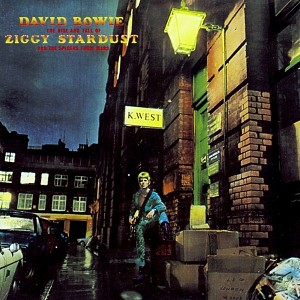
Ziggy Stardust and the Spiders From Mars – one of the first albums I ever bought
The Spiders as a band name probably had its greatest success in 1972, when David Bowie and The Spiders From Mars shot into the rock stratosphere. Now it seemed the world could fully accept a group of musicians named after the kind of creatures that Buddy Holly had to turn into crickets.
Weather Report
Weather Report were a jazz fusion band of the 1970s and 1980s. As well as recording wonderful music, they came up with a band name illustrating the effort that has to go into finding just the right words. In 1970, pianist Joe Zawunil, saxophonist Wayne Shorter, and bassist Miroslav Vitous, all luminaries of the jazz scene, decided to form a new band. They did not, however, have a name to describe themselves and their music. Zawunil, in an interview with Jazz Forum magazine, recounted how the three of them met at his New York apartment and went through countless names. They kept coming back to Daily News. Knowing this wasn’t quite right, the struggle continued, until Wayne Shorter pondering on the fact that news programmes always ended with a weather bulletin, suggested Weather Report. Weather Report is a better band name than Daily News because it is difficult to see a jazz band as a group of journalists. A clear story does not arise from their free flowing music. Daily News is too literal. Weather Report tells a different story. The weather is vast and ever changing, benign, glorious, dull, violent. Our ability to understand and predict the weather is partial. It’s like listening to music. We’re aware of pattern and meaning there, which remains enigmatic, beyond our ability to fully comprehend.
Weather bulletins always come after the news, a tacit admission perhaps that talking about weather is shorthand for talking about nothing important. Nevertheless, despite their position at the bottom of the news pile, weather reports can pass on information that will blow your house away. Music is harmless entertainment, and a force with enough power to move millions. It’s a breeze on a sunny afternoon and a landscape-changing storm. None of this is in the Daily News; it’s all in the Weather Report.
Abbreviated Rock
Between 1967 and 1969, Marc Bolan led a psychedelic folk group called Tyrannosaurus Rex, which didn’t do very well. In 1970 Bolan moved to an electric sound, and modified the band’s name slightly. T. Rex went on to become one of the most influential forces in 1970s rock. T. Rex was a better name than Tyrannosaurus Rex. Let’s have a think about why that should be. T. Rex is an abbreviation, where letters are missed at the end of a word. Abbreviations can also take the form of contractions, omitting letters from the middle of a word, as in Mr; or an acronym, where different words are formed into a single set of letters, as in USA. All these reductions of language have the same effect. They concentrate ideas into something short and pithy; or bring diverse things together into one whole. They also take the form of a simple code, which tends to create a sense of excluding outsiders. There’s a suggestion of secrecy, belonging, exclusivity and power. It’s no surprise that many countries have been identified by abbreviations – USA, UAE, USSR, GDR, UK, DPRK. It’s also no surprise that abbreviations are popular with the military, in management speak and in academic titles. Ironically, however, there can also be an informality associated with shortened language. Abbreviations can be rebellious, disrespectful, conveying a subversive improperness. Bands that use abbreviations in their names tap into all of this. There are many examples – AC/DC, R.E.M., ABBA, REO Speedwagon, Booker T and the M.G’s, Guns N’ Roses, INXS, UB40, MC5, Run DMC, UK Subs, UFO, X-Ray Spex, ZZ Top, CSNY, OMD, ELO, 10cc, U2, AWOLNATION. The power of the abbreviation effect is illustrated by the fact that removing one letter can make all the difference. Led Zeppelin dropped a single a. The Lovin’ Spoonful dropped a single g.
Such is the attraction of elision that sometimes band names not intended as real abbreviations have been treated as such by imaginative fans, or by suspicious moral guardians. KISS was not an acronym, but that didn’t stop people finding Kids in Satan’s Service hiding in those four letters. The heavy metal band W.A.S.P. only put full stops between the letters of their name because they thought it looked cool. They left interpretation of their meaning to both their fans and detractors. So there you have it – T. Rex has a louder roar than Tyrannosaurus Rex. That’s the power of abbreviation as illustrated by band names.
Fleetwood Mac and Rumours
Daisy Jones and the Six is a novel by Taylor Jenkins Reid. It tells the tale of a fictional 1970s rock group making a massively successful album. The book is clearly inspired by Fleetwood Mac, and their experience of making the Rumours album. While the book is very good in its exploration of complex creative endeavour, it also demonstrates the power of actual great names, by contrast to inferior fictional names. Compare the name of the fictional album Aurora with the name of the real album Rumours. The title of Fleetwood Mac’s most famous album is deceptively simple, introducing its collection of songs in terms of the kind of enigmatic hearsay into which people can read their own concerns. Rumours circulate in times of trouble, and you never know where you are with them. Aurora by contrast is the sort of title which sounds impressive, but which is kind of straining for significance. And the fictional band name, The Six, does not compare with Fleetwood Mac, an abbreviation of the names of founding members Mick Fleetwood and John McVie. The name of the real band is less literal, and has the characteristically enigmatic quality that lies in all abbreviation. It also has a pleasing musical rhythm to it.
Blondie
Blondie is the name of an American rock band fronted by Deborah Harry. According to Rolling Stone magazine, Blondie has sold in excess of forty million records over the course of a career starting in 1974. For a single word, Blondie has a lot to say. First, there is the biographical background it reveals. After graduating with an arts degree in 1965, Deborah Ann Harry worked at BBC offices in New York, then as a waitress, a go-go dancer and a Playboy Bunny. I don’t know if young Deborah found herself called Blondie at the BBC, but in her waitressing and dancing jobs, this was how men often refered to her. The first thing to note about the name Blondie is the “ie” ending. This sound often denotes something small, insignificant, playful, charming, as in cutie or sweetie. The linguist Otto Jespersen has suggested that the effect of ie is to convey a childlike quality. Children tend to add an ie sound – one of the easiest to produce – at the end of words as they begin to learn language. So Blondie has this suggestion of something cute and childlike. Those characteristics then collide with the reality of Blondie as a hard-hitting rock band. Blondie now takes on a different nature. There is something tough in the name, a denial of intimacy and individuality. It’s a generic nickname for fair-haired young women, which while starting all cutesy in the nursery, has now taken us into seedy bars and clubs where superficial adult relationships are playing out.
The music Blondie made is like a novel based on the short story of their name. Listening to my favourite Blondie album Parallel Lines, we meet Sunday Girl, “as cold as ice cream but still as sweet.” Heart of Glass, portrays a similar character. A glass heart suggests someone tough and unemotional, but also fragile and vulnerable . In One Way or Another, a cold hearted girl is both a stalker making dark threats, and a playful little thing, giving you the slip in a game of hide and seek. There’s Pretty Baby – that ie sound again – about a young girl trying to separate the fantasies of romance from reality. Picture This, is a love song to the fictional vision of a loved one rather than an acceptance of their reality. Fade Away and Radiate, similarly, paints a picture of someone watching a film, who feels a deeper connection with a silvery screen goddess than with real people in daily life. Finally, there’s a line in I Know But I Don’t Know, about how “I’m your dog but not your pet.” Blondie is a pet, a bunny, a cutie, the vision of a perfect, undemanding companion; but you’d be wrong to think that this pet isn’t an animal with teeth. So there you are – Blondie, an album of songs in itself.
Queen
The band that became Queen was originally called Smile. Based in London in 1969, Smile consisted of guitarist Brian May, drummer Roger Deacon, with Tim Staffell on base and lead vocals. Staffell left the group in 1970, to be replaced by Freddie Bulsara, who had decided to adopt the name Mercury. He also changed the band’s name to Queen.
Queen was a much better name than Smile, which is one dimensional. Smile is an expression of happiness. That’s about it. There is no sense of the Janus mask that would include an expression of sadness. By contrast, Queen glitters like a jewel with many facets. First there are the suggestions of operatic grandeur, a sense that this band is respectful, embodying traditional qualities of skill and competence. Symphony orchestras, choral choirs, pomp and circumstance can be found here. A listener is welcomed to the palace, where you will be received with the most impeccable of hospitality. And yet… Queen is a term that refers to homosexuality, to men who dress up as women, inhabiting a semi-secret world of sequins, and songs by Gloria Gaynor. Queen suggests both the establishment and a profound antiestablishment rebelliousness which allows us to escape from the rigid convention of the palace and head to a drag club. All of that is in Queen. The name is respectable and disreputable, rebellious and conventional, epic and self-deprecating. Queen is a Janus mask of contradiction rather than a simple smile. It welcomes the conventional and the marginalised. There is room for everyone in the palace of Queen.
The Smiths
The Smiths in 1985 Continuing my irregular series of articles on band names illustrating artfully selected words, we now come to The Smiths. I knew there was a lot going on with this name, so I read Johnny Rogan’s massive Smith’s biography The Severed Alliance. And after reading all those hundreds of pages, I came to the conclusion that the two words The Smiths used to identify themselves might qualify as their definitive achievement. This comment is not as flippant as it might seem. During his 1970s schooldays at a tough Manchester secondary modern, future lyricist and lead singer, Steven Morrissey retreated to his bedroom, taking refuge in the music of Sandie Shaw, Cilla Black, Marc Bolan, and the New York Dolls. With vague creative ambitions of his own, young Morrissey would enjoy making up clever book titles and chapter headings for novels that never happened. Morrissey seemed better at the flash of insight rather than the long slog of consolidation.
Once he left school our unlikely hero joined forces with guitarist Johnny Marr, and against all odds became a singer songwriter himself. At this point, Morrissey came up with his best title ever – The Smiths. The name implies so many things. First, there is that sense of a back to basics approach, as a reaction to glam rock, or pompous concept album rock. Yet this is not back to basics in the sense of a Punk band thrashing around on instruments they learnt to play last week. Instead, there is a suggestion of artisanship. A smith labours in a sweltering smithy, making horseshoes and ironwork. This is a person who upholds traditional values of application and honest service.
At the same time, there are darker undertones to explore. Originally, the band considered the name Smiths Family. The word family implies togetherness. Think of The Partridge Family – sunny and happy on a bus with David Cassidy, his mom and cute siblings. The Smiths, or The Partridges, divested of the word family, conjures more of a vision of one of those clans who fight amongst themselves, using any energy left over to terrorise their local area. The Smiths had much of the anti social behaviour order about them. Their shows were famously rowdy, with Morrissey welcoming a good stage invasion. He could also be relied upon to provide controversial quotes, supporting the violence of the IRA, or the extreme fringe of the animal rights movement.
The name is also strangely reflective of the times the band lived through. The 1980s was a divided decade. Prime Minister Margaret Thatcher would often refer to her personal values resulting from a Methodist upbringing in a greengrocer’s shop in Grantham – solid virtues of hard work, thrift, and respect for the rule of law. Yet she was also profoundly confrontational, having no time for consensus, compromise or the status quo.
Margaret Thatcher’s hope was that the 1980s would turn Britain into a kind of vastly successful greengrocer’s shop, or smithy. But there were so many contradictions – the talk of thrift, honesty, hard work, set against the flashy lifestyle and murky ethics of the money-driven society the Thatcher government helped encourage. There was also that conflict between harking back to supposed traditional values of application, self reliance and the rule of law, whilst also rejecting equally traditional values of respect for compromise and consensus. Amidst the resulting confusion it is perhaps not surprising that the 1980s were violent years defined by miners’ strikes and city centre riots. This was a decade yearning for lost values, even in wanting to tear them apart. By some miracle, all of these conflicting forces were held together, for a few years at least, in The Smiths
Titles of Travel
On this journey through band names and song titles, it would be fitting to consider the theme of travel – a characteristic preoccupation of song writers. Songs have long acted as aids to travel. Tramping feet and the stroke of oars follow a steady rhythm. Songs once served a practical purpose in smoothing this rhythm, a process reminiscent of tuning an engine. There is, however, more to a song than providing a beat, just as there is more to a journey than getting to a destination. Consider Bob Dylan’s 1965 album, Highway 61 Revisited. The real Highway 61 paved the way for Bob Dylan to follow his song writing dreams, running from the Canada/United States border, through Duluth – where Bob Dylan was born – and on down through America to New Orleans, one of the early homes of modern popular music. On the way, the road passes close to Memphis – where Elvis Presley lived at Graceland – and Clarksdale, birthplace of Muddy Waters. The Blues singer Bessie Smith died in a car accident on Route 61 near Clarksdale. Clarksdale is also the place where Highway 61 meets Highway 49. This crossroads is a musical tourist attraction, commemorating a young Blues singer named Robert Johnson, who is supposed to have offered his soul to the Devil at this spot, in return for musical ability.
Bob Dylan gets his camera and sets off to explore this long series of musical milestones. The crucial word in the title of Bob Dylan’s strange travelogue is “revisited”. Apart from the sense of going back on yourself, there is something odd about the word revisited when applied to a road stretching for 1,400 miles. We usually use a road to visit a particular place. Highway 61 is a place in itself, one long series of arrivals and departures in a world associated with music.
Highway 61 is the opposite of the Yellow Brick Road, as immortalised by L. Frank Baum in The Wizard of Oz. The Yellow Brick Road is like one of those coloured lines at Victoria Station, existing for one purpose only – to guide a traveller unerringly to a destination, whether that’s the taxi rank or, in the case of Baum’s story, the Emerald City. It is interesting that when Elton John came to reference the Yellow Brick Road in the title of his massively successful album of 1973, it was to say goodbye to such a road. Highway 61 is notable for itself as much as for where it goes. The Beatles who named an album after a road, are known for crossing Abbey Road rather than travelling along it. Harking back to Robert Johnson, it seems that in people’s imagination, music is more associated with crossroads than destinations. Think of the difference if Abba had called their Arrival album Arrived. Arrival is a process which continues. It involves marching bands and excitement. Arrived is something finished. Arrived is what happens when Dorothy and her friends reach the Emerald City and find it’s a sham.
It only takes a small detail to transform the mundane description of a journey into something musical. Consider the band Supertramp – a band with a great name when it comes to endless journeys. In 1979 they took a trip across the Atlantic on an airliner in the title of their album Breakfast in America. Breakfast in America suggests a long, trans-Atlantic night flight, while the detail of breakfast at the end of it suggests a brief pause before the journey continues on somewhere else. It is the beginning of the day after all, not the end. Breakfast in America is a much better musical title than, for example, Lunch in America. And as we are in New York we could remember the vocal group Manhattan Transfer – taken from a novel by John Los Passos actually, but a great band name, suggesting a definite place which is only designed to move you on to another one.
A Final Journey – Street Legal by Bob Dylan
Street Legal is Bob Dylan’s eighteenth studio album, released in 1978. It peaked at number 11 in the Billboard Charts, the first time a Dylan studio album had not reached the top 10 since 1964. Though Street Legal might not be Bob Dylan’s most commercially successful and critically acclaimed album, I think it has one of the best names of any album ever made. This two word title is a poem in itself.
So let’s have a think about these two words, street legal, which refer to a vehicle licensed for normal road use, meeting various criteria related to equipment and safety. These criteria exclude more rarified or specialised vehicles – racing cars, off-road dune buggies, and so on. There is a sense of compromise as Dylan sets out on the road to meet his audience. He has to make sure his lights and indicators are in order. Are his rear view mirrors correctly positioned? Does he have his road tax and MOT documents up to date? He’ll need those if he’s visiting people like me in England. I know this does not sound glamorous or exciting. Something certainly seems to be lost when you decide to step out of a racing car into, say, a Hyundai i10.
However, as you make that compromise, a huge new world opens up. You’re not racing pointlessly around a tiny track anymore, or jumping over the same old sand dunes. With your indicators and side lights in good working order, a whole new vista opens up. You are now free to follow the road wherever it may lead. This is a vista revealed by the ordinary rather than the special. You don’t have to be a rock star to make this journey. In fact rock stars risk getting left behind, at an exclusive golf club perhaps, riding in a golf cart, which like a racing car or dune buggy, is not street legal.
An album is a communication, a reaching out. It takes a journey from one person to another in a street legal vehicle. When I think of Street Legal, I think of something like Van Gogh’s portrait of postman Joseph Roulin, an ordinary fellow in an unremarkable job. He sits there, unassuming in his bushy beard, dark, buttoned coat, and his station master’s hat with “Postes” in gold lettering across the front. No one in 1888 could assist in communication between people more than an ordinary postman. The same is true of Bob Dylan in his Street Legal vehicle of 1978.
Manhattan Transfer is a novel by John Los Passos published in 1925 and much admired at the time by D.H. Lawrence, Ernest Hemingway and Sinclair Lewis. It describes life in New York, from the 1890s to the 1920s. This is not a single story, but an intermingling of dozens of narratives, seen from the point of view of a wide range of characters – wealthy college drop outs, lawyers on their way up, business men on their way down, tramps, actresses, journalists who have a vague idea to quit journalism and write a great novel. Some characters develop across the entire book, others only appear for a few lines. Point of view can shift from paragraph to paragraph.
Although this might sound potentially confusing and difficult to engage with, that was not my experience. The book worked as a whole, carrying me along so powerfully that I might as well have fallen into the swirling currents of the Hudson. I suppose this is because, amongst all the chopping and changing, there is a steady central character, and that is New York itself, portrayed in great descriptive passages. Some of the most vivid writing is reserved for New York at dawn, the beauty of early morning coinciding with many crises and turning points. The sunrise sums up the nature of the city, which has a machine-like relentlessness of operation, running on regardless of the people living there, which it often seems to use as fuel. And yet, whether dawn is bright and summery or cold and wintery, it always has an airy, ethereal, beauty, and is never the same twice.
Now, this next bit might not seem very literary, but I’m going to risk getting scientific for a moment. Bear with me. Recently I happened to be reading about this thing in Chaos Theory called ‘emergence’. Emergence is when a system changes according to the individual actions of its constituent parts adapting to circumstances without centralised goals, plans or coordination. These systems exhibit chaos and unpredictability in their development. However, despite their lack of plan, emergent systems tend to become efficient, complex and highly adapted over time. Examples of emergent systems include capitalist economies, societies, cultures, and, of course, cities – like New York. No one person or organisation set out to make New York as it now is, and yet here it is, a vast, almost mathematical grid of streets. Emergent systems are random and also highly ordered. I hesitate to stray into areas I don’t really know much about, with the associated risk of embarrassment; but I’m going to just put out there some interesting parallels between an account of the development of a modern city written in the 1920s, and aspects of a theory of complex systems devised by Edward Lorenz in the 1960s.
Whether Chaos Theory is relevant or not, there is a very modern feel to Manhattan Transfer, as remarked upon by the book’s eminent early admirers. It’s a fascinating, thought-provoking story, with some beautiful descriptive writing.
The Midnight Library is a kind of philosophical fantasy, set in a half-way house between life and death. This place takes the form of a library where a troubled young woman called Nora Seed gets to look at all the lives she might have led if she had made different decisions.
To read a book is often to experience a different life, and I think it’s always better to see the good things about a book rather than look for negatives. This is also the message of The Midnight Library. So we seem to be off to a good start. Stretching for the positives, I did think that to some degree The Midnight Library found a version of Groundhog Day wisdom – taking the one life you have and seeing it in a better way. The subject of the story is interesting and gets you thinking.
But I have to admit there were aspects of this book I did not enjoy. Whereas Groundhog Day has a neat and charming central concept based on recognisable daily routine, the metaphor of The Midnight Library is a convoluted mishmash of quantum physics and parallel universes, no less. Basing your fictional universe on something like quantum physics is a bit like basing it on religion, something so abstruse as to be unchallengeable. You just have to trust in the author’s higher power. A simple reader like myself can hardly object to something he doesn’t understand. Well, respectfully, I would like to object. I do wonder how much a fiction author can really know about the outer reaches of physics. In one of the various lives lived via the library, Nora finds herself in a study where a few books on popular science are described as sitting on a shelf. Personally I think those books are somewhat reflective of the scientific knowledge in The Midnight Library. I’ve read a few popular science books too, including A Brief History of Time – thank you – but I don’t think that would qualify me to start getting metaphorical with quantum physics. And although I don’t know much about the subject, I do feel that whatever the universe is about at the quantum level, it probably doesn’t involve giving people lots of lifestyle options. That just didn’t make sense to me. It came over as a strained plot device.
The retrospective imagining of different possibilities was a good premise for a story. We can all identify with someone looking back over their life and imagining how things might have gone with different choices. But all the complicated underpinning just lost me. It would have been much better without it.
I suppose, there is also my personal feeling that life isn’t an endless series of choices leading in countless directions. Yes there have been turning points in my life where things could have gone this way or that, but the idea that I could have infinite other lives by making different decisions just doesn’t seem reasonable. For a start if I were to be a specialist in Latin ballroom dancing, or a pilot in an aerobatic display team, then I would have to be a totally different person with hips that move and eyes that aren’t short sighted. I recall reading Tolstoy’s War And Peace in a confused period after university, when it was difficult to know which way to go. War And Peace is a long study of peoples’ ability – or lack thereof – to make decisions about the direction of their lives. Tolstoy portrayed human choices as in some way fated. Perhaps that influenced me at a crucial moment, and informed the rather laid back view I have had of choices ever since.
This book wasn’t for me. Physics might be about objective truth, but fiction is about ringing true, which is a bit different, more subtle, and more prone to individual experience. So if it worked for you I’m glad, because it is always better to enjoy a book. But it didn’t work for me.
Winesburg, Ohio is a collection of short stories by Sherwood Anderson. Published in 1919, all the stories are set in the fictional town of Winesburg, Ohio, based apparently on Clyde, Ohio where Andersen grew up. Although the stories feature a range of characters – farmhands, troubled school teachers, clergymen tortured by guilty lust, for example – the book as a whole is loosely centred on George Willard, a young journalist.
This is an unusual book, especially for its time. The writing is economical and straight-forward, when most authors were taking a wordier approach. There is very little plot, more the describing of atmospheres and psychological states, corresponding with periods of crisis or turning points in people’s lives. The linked short story structure was innovative.
The whole book seems to be about transitions rather than neat and tidy endings or beginnings. Winesburg stands part way between a rural past and an urban future. People look for definite things to believe in, but always end up with partial truths. The stories tend to peter out rather than concluding with some definite point. The railway is mentioned constantly. People go somewhere else before coming back again. And yet for all this sense of transition, Winesburg seems to be a place that is very difficult to leave.
The book culminates with George Willard, the young journalist, deciding to escape. He gets on a train at the station, determined to start a new life elsewhere. But as he does so there are indications that escape will be more difficult than he imagines. George may think he is leaving, but from the point of view of Tom Little, conductor on George’s train, Winesburg’s physical borders are fuzzy to say the least. Tom spends his working life in a kind of elongated ‘town’ which, starting with Winesburg, is made up of all the places along the track.
‘He knows the people in the towns along his railroad better than a city man knows the people in his apartment building.’
Unlikely as it may seem, I found myself thinking of the surreal 1960s TV show The Prisoner, where a British secret agent finds himself trapped in a mysterious seaside village. Big white balloons keep thwarting his escape attempts. Winesburg is tiny, but somehow, no matter how far you go, you can’t seem to get away from it. Some of the stories show Winesburg as beautiful, others as ugly, cold and bleak. There was the same ambivalent feeling in The Prisoner, where the mysterious village is deeply unsettling and also charmingly picturesque. Recalling the series, I can imagine that instead of getting stressed out trying to escape, I might settle down in one of the colourful apartments with a word processor and a pile of good books, one of which could be Winesburg, Ohio. Anyhow, I digress. The fact that I digress about a 1960s sci-fi television show, indicates the strangely modern nature of this selection of stories.
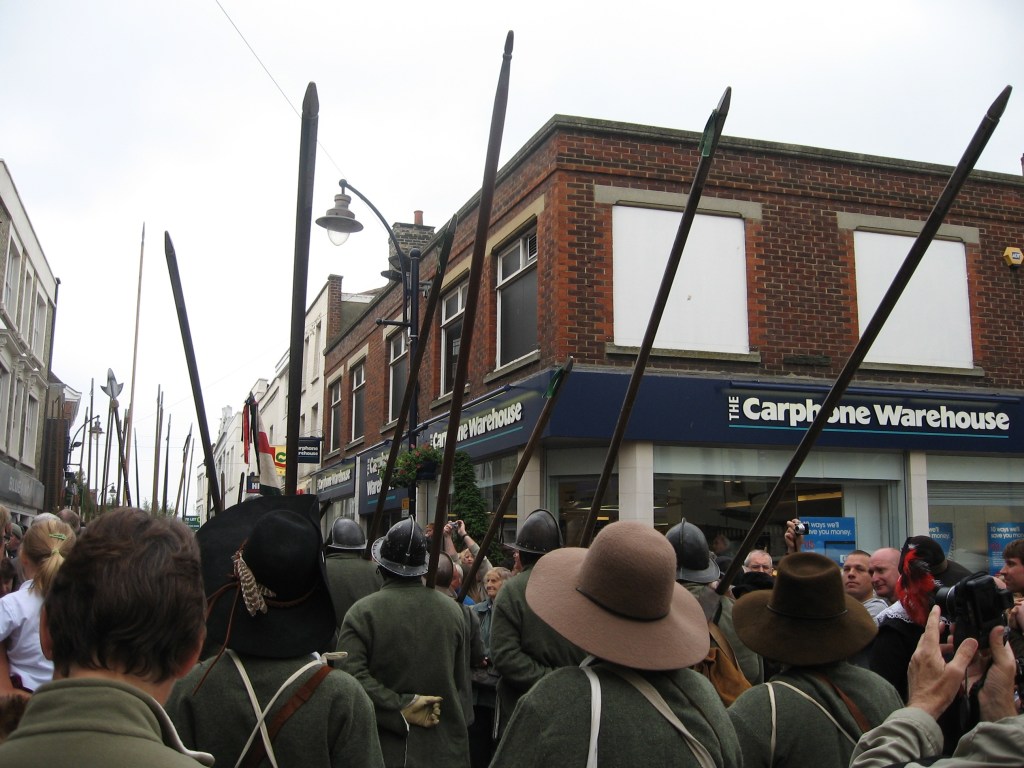
In the royalist ranks at a 2008 recreation of 1648’s Battle of Maidstone
In 1642, civil war broke out in England. King Charles I and forces loyal to him, faced a rebellion led by Puritan religious fundamentalists. The rebels captured and beheaded Charles I in 1649. His son, Charlies II, continued the fight for two more years, before fleeing into exile. Oliver Cromwell then established his Protectorate, which endured, rather shakily, until the restoration of the monarchy in 1660.
Robert Harris sets his historical novel, Act of Oblivion, in the aftermath of these events. With Charles II back on the throne, his government passed the Indemnity and Oblivion Act, which issued a general pardon to anyone who had fought against the royalists. However, a small group of people were exempt from the Act, notably anyone who had signed the death warrant of Charles I. These ‘regicides’ were to be tracked down and executed. Some were captured immediately, others handed themselves in, hoping in vain for clemency, while a third group went on the run. Act of Oblivion is an imaginative reconstruction of the lives of regicides Edward Whalley and William Goffe, who spent years evading capture in the American colonies.
In some ways the relationship between this book and actual history is loose to say the least. The character around which the story revolves, Richard Naylor, fanatical regicide hunter in-chief, never existed, although someone like him might have done. But before we get too purist, it’s worth remembering that creating any kind of historical narrative requires choosing some events and not others, which inevitably denies the messy nature of what actually happened. You could say that Richard Naylor is a personification of this artificial shaping process, a fictional centre around which historical events can be arranged.
Another typical way to arrange history is to choose events likely to resonate with present-day readers. In this case, potential readers live in a world where national division has increased in various major countries, and where extremists have become more prominent. The Civil War, it goes without saying, was another time of national division and extremism.
So a story playing fast and loose with history, actually tells us much about how history gets written. Richard Naylor as an artificial shaping device, lurks in every history book, whether he is acknowledged or not. And as for the resonance of the chosen subject for contemporary readers, this book offers its audience the chance to explore the complexities of conflict and fanaticism at one remove. Act of Oblivion makes it clear that divisions, of even the most vicious nature, hide a reality where enemies have more in common than they realise. Robert Harris doesn’t have to make up facts about people on opposing sides in the Civil War being friends, or that moderation and zealotry were present in both the rebel and royalist camps. Overall, this compelling historical story is truthful about the contradictory nature of human relationships, rather than about the exact nature of events, which we can never fully know anyway. That’s what makes this a good novel, rather than a dodgy history book














 Writing And So On