Now And Then Album Cover – Living on a Diagonal

In November 2023, The Beatles released their last song, Now and Then, with front cover art by American artist, Edward Rushcha.

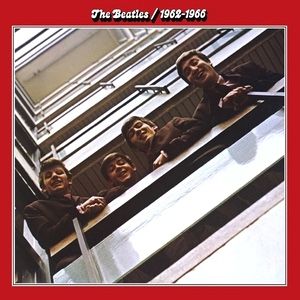
Observant fans have drawn comparisons between the Red and Blue compilation album covers and the Now and Then cover, in the sense that they all feature diagonal lines. Is that just a coincidence? Or does this type of line have a role to play in producing an interesting and fitting image?

Let’s start with those Red and Blue album covers. The Beatles are pictured on the internal stairway at EMI House in 1963 and 1969. The stairwell balconies create a set of diagonals. These images could have been presented face on, but photographer Angus McBean tipped everything sideways. In photography or art, horizontal and vertical lines naturally suggest stability and structure. Diagonals, by contrast, bring a sense of dynamism, excitement, instability or insecurity. In the words of Cornell academic Charlotte Jirousek, an object on a diagonal line is always unstable in relation to gravity. The Red and Blue era Beatles appear happy enough, but the angled balconies imply something like a sinking ship. The exciting and terrifying experience of being world famous, while creating music of turbulent reinvention, certainly must have been ‘unstable in relation to gravity’.

Now and Then has been billed as the last Beatles song, but lyrically it’s really about continuing emotional uncertainty, and does not suggest an end. The cover reflects this. Apart from the diagonals, the image is ambivalent in how solid it appears to be. The background colouration could be seen either as a flat plain, on which the diagonals sit as folds, or as a gauzy, misty, watery surface with depths beyond. We have not reached firm ground. Everything is still slipping and sliding, and we cannot be sure of our footing. In fact Rushcha’s cover makes me think of words associated – accurately or otherwise – with John Lennon: ‘It’ll be alright in the end, and if it’s not alright, it’s not the end.”

(Images courtesy of Wikipedia Commons)

Post script

Post script

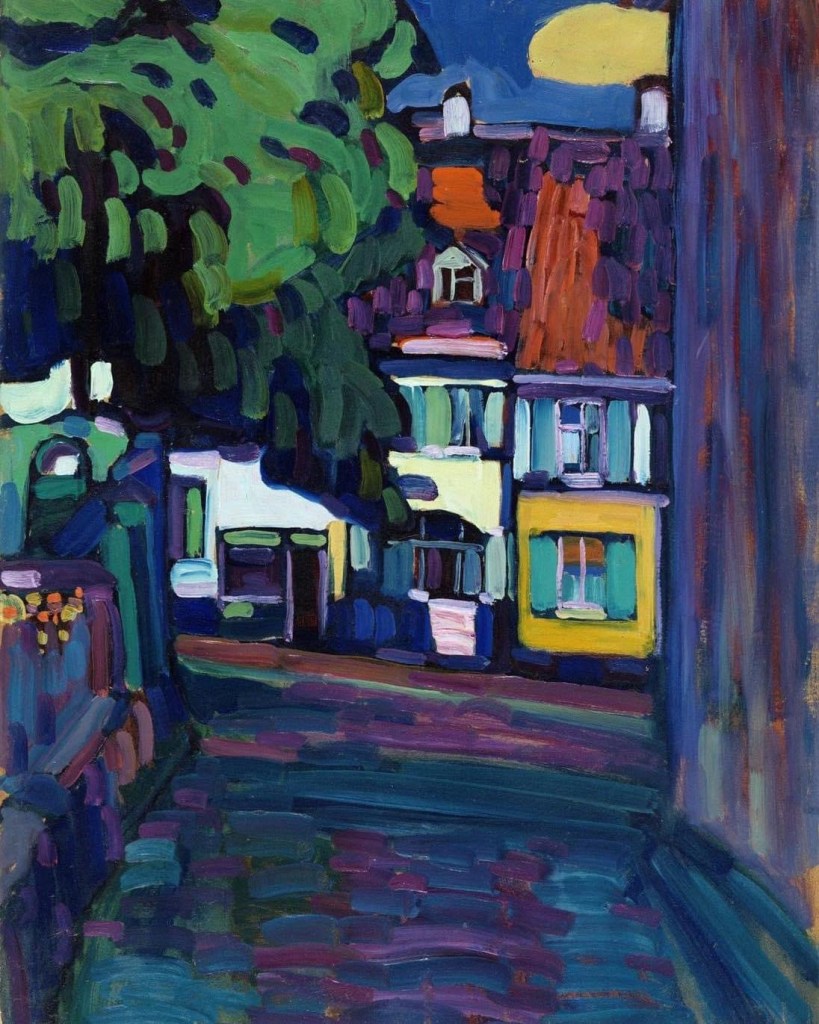
I follow various art institutions on Facebook. Here are pictures posted to my feed in the few weeks after writing this article. It is an arbitrary selection, but just look at all the diagonals…

Houses in Murnau on Obermarkt by Wassily
Kandinsky
Le Bistro by Edward Hopper
Manson Maria with a View of Chateau Noir by Paul Cezanne
Road at St Paul by Felix Vallotton
Farm at Montfoucault by Camille Pissarro
Kiental mit Bluemlisalp by Eduard Boss

Skippy Dies by Paul Murray – a Theory of Doughnuts, the Universe and Everything

Skippy Dies is Irish author Paul Murray’s second novel, published in 2010, and long listed for the 2010 Booker Prize.

The story starts with the death of Daniel Juster – or Skippy to his friends – in a doughnut shop. We then go back to events leading up to Skippy’s demise, before moving on to a dramatic aftermath.

In some ways this is an old fashioned book, set in a posh boarding school, describing the humorous antics of pupils and teachers – reminding me of Kipling’s Stalky and Co., and Joyce’s Portrait of the Artist as a Young Man, both of which I’ve read recently. On the other hand, Skippy Dies is very modern. The boarding part of the school is old and decrepit, earmarked for rebuilding. The involvement of the Catholic Church in running the school is winding down, an unpleasant, management-speak acting-principal manoeuvring to take over from an ailing incumbent. The pupils have modern concerns, whether that means video games, fast food, drugs, or in the case of one scientifically-inclined boy called Ruprecht, string theory. The story also has a harsh edge of realism, which makes Stalky and Co. at its most unpleasant, seem traditionally well-mannered by comparison.

Thinking about what I made of it, I kept recalling one particular scene where a group of boys discuss Robert Frost’s poem, The Road Less Travelled. Dennis, the class cynic, thinks it’s about less than orthodox sexual practices, which seems a crazy idea, but which actually makes perfect sense of the poem. I thought of Skippy Dies in this way – a book presenting life as a confusing mess, where any interpretation of its ‘meaning’ is going to make you sound like a schoolboy with mad ideas about the poems of Robert Frost. And yet… the mad meaning actually seems to make sense of what you’re reading. String theory boy, Ruprecht, is continually trying to come up with a scientific concept that explains the universe. If there is any theory explaining the Skippy Dies universe, it is a contradictory scheme that is complete nonsense but still, in an odd way, hangs together. Maybe if scientists do ever come up with a theory that explains the universe, it might be nice if it’s something similar, an explanation that leaves much to explain.

This is a big, sprawling, funny, tough book with lots of scientific and historical ideas colliding with doughnut eating and cynicism. It’s certainly fun to read, though some sections are distinctly discomforting. Overall, a traditional-feeling book with a modern message.

A Portrait of the Artist as a Young Man by James Joyce – A Review Lacking Conviction

Published in 1916, A Portrait of the Artist as a Young Man is a semi-autobiographical novel by James Joyce, charting the development of Stephen Daedalus, an able and artistic boy living in early twentieth century Ireland.

Change in the boy’s life mirrors change in the wider world. First we see Stephen as a young child at home with his well-to-do parents, confused at the Christmas dinner table, as family and friends argue about religion and Irish nationalism. Stephen then has a Catholic schooling, where graphic descriptions of hell leave him terrified that his adolescent sexual adventures will consign him to an eternity of fiery punishment. He decides to follow Church rules to the letter, only to grow out of his religious phase, and begin studying science in Dublin. Growing out of science, he has lots of intellectual conversations with other students about definitions of beauty, and decides at the end of the book to leave Ireland and become a poet.

This individual path reflects the world generally, as society moves from faith in religious certainties, to confidence in science, to a modern situation where people are just not so sure of anything anymore.

Does all this make for a good book? Some people think it does. Others disagree, which is quite fitting really.

Personally, I found the book more interesting than enjoyable. During Stephen’s religious period, descriptions of hell’s trials went on for so long, I skimmed a few torments. Sometimes I found Stephen’s intellectual conversations tiresome – a youngster showing off. The portrayal of a student who likes the sound of their own voice was clearly intended – more down to earth fellow students puncturing Steven’s pomposities – but that didn’t make these sections any less wearying to read.

That all said, there were things I enjoyed and admired about the book. Some of the poetic prose was lovely – like memorable lines describing swallows forever working in the eaves of houses to make temporary nests. I was also fascinated by reflections on nationalism. People were busy seeking out clear national identities during Stephen’s young lifetime, maybe as a reaction to a growing loss of religious identity, which had given succour and a sense of belonging for millennia. As an Irish boy, Stephen remarks on expressing himself in English – a language not his own. But like his student mates, he often throws in bits of Latin to conversations, the language of the Roman Catholic Church. This quietly tells us that English people don’t speak a language of their own either. English, like nearly every European language, has a great debt to the ancient language of Italy. For all the sound and fury they generate, national certainties are as shaky as any other. And maybe that’s no bad thing, since rampant nationalism was a major factor in the world war raging as Portrait was published. Loss of dogmatism can make us safer rather than more vulnerable. As the Irish poet Yeats says in one of his most famous poems, ‘the best lack all conviction, while the worst are full of passionate intensity’.

So, I can see why some readers gave this book five stars. I also sympathise with those who gave one. On a purely personal level I’m somewhere in the middle. I think James Joyce would think this a perfectly acceptable place to be

The House of Doors by Tan Twan Eng – Shut That Door!

The House of Doors is a novel by Tan Twan Eng, published in 2023 and long-listed for the 2023 Booker Prize.

Lesley Hamlyn, a widow living alone in South Africa, takes delivery of an old book of Somerset Maugham short stories, called The Casuarina Tree. This sends Lesley back in her memories to 1921, when Maugham, a friend of her husband, stayed with the Hamlyns in Penang, Malaya. Travel for Maugham served as an escape from an unhappy marriage, a chance to conduct an affair with his secretary Gerald Haxton in relative safety, and an opportunity to gather material for his work. Lesley told the visiting writer lots of stories, from her own, and other people’s lives, some of which appeared in The Casuarina Tree.

A novel about a famous writer does naturally invite comparisons. Before reading The House of Doors, I read The Casuarina Tree. One of the most striking differences between the two was the ‘voice’ of the books. In The House of Doors, a character says something along the lines of ‘I remember as if it were yesterday’. And then we’re supposed to believe that the ensuing prose, with dialogue and fancy descriptive passages, is their spoken account. When people in The Casuarina Tree tell stories, they do so in their own voice, rather than that of a novelist. In comparison with Maugham’s straight forward style, The House of Doors felt a little forced.

Nevertheless there’s much in The House for Doors that I did enjoy. Let’s start with the setting of Penang, a fascinating, tolerant, easy-going city, where all kinds of people from Asia and Europe rub along together. Ironically, Penang, for a while at least, also provides safe harbour to Chinese revolutionaries who are uncomfortable with different people rubbing along together. They disapprove of the ‘Straits Chinese’ – Chinese migrants who have intermarried with people in the Malay Peninsula. Tolerant places can find themselves in the hazardous position of tolerating people who are temperamentally intolerant. One of the many stories Lesley tells Maugham involves a man who collects decorated local doors, which hang, disembodied from walls, in his personal door museum. If Penang has a door between itself and the outside world, then it’s this kind of suspended door, lovely to look at, but maybe not offering the sort of five lever mortice deadlock that an insurance company might require. Interestingly the owner of the door museum, a Maugham fan, decorates the actual front door of his eccentric door repository with Maugham’s personal symbol, placed at the beginning of his books. This is a hamsa, found on travels in Morocco by his father, a Moorish symbol to bring good luck and ward off the evil eye. The hamsa seeks security, and seeing it on the museum door had me thinking about the contradictions of security. A sanctuary is not necessarily found by slamming the door and bolting it shut. And yet, there are also risks in leaving the door open, giving entry to intolerant people who might endanger a tolerant place.

In the end, however, I think The House of Doors comes down on the side of doors which are appreciated for their beauty rather than for their reinforced hinges, spy holes and strike plates. I think if Maugham had been able to read The House of Doors, he would have enjoyed the fact that now his secrets could finally be fictionalised by another author, without risk of career-ending scandal and imprisonment.

Money by Martin Amis – A High Rate of Interest

Money, by Martin Amis, published in 1984, tells the story of John Self, a London advertising man, brought up partly in America, partly in a London pub called the Shakespeare. He’s a monstrous consumer of junk food, cigarettes, alcohol and pornography. His ad campaigns sell the virtues of products like the Rumpburger. John Self is a tough, nasty bloke who throws his weight and his money around. John, however, has one weakness. There is something in him that wants a finer, better life. This leaves him vulnerable to those who would exploit people who think there is a finer, better life to be had.

John has a fancy that his experience of growing up in the Shakespeare would make a good film. A New York film producer apparently believes in this dream. John Self is now as vulnerable as a young writer seeing an ad for a vanity publisher promising bestsellerdom for a fee.

John’s tough and diffident search for a better life is extremely funny. I tried to suppress the laughter because, firstly, I was laughing so often, I thought this might be unsettling for anyone close by. Secondly, a lot of the stuff making me laugh wasn’t actually a laughing matter. So I spent most of my time reading Money in a state of painful suppression, which risked triggering an asthma attack, or maybe causing damage to sinuses, or the inner ear.

When I wasn’t trying to stifle laughter, I was also enjoying the book on a thoughtful level, For all its downmarket strut and swagger, Money is an interesting reflection on the nature of culture. There’s energy in the low brow culture that John goes in for. This is lacking in the high arts to which his posh New York girlfriend, Martina, tries to introduce him. But even as John makes his effort at self improvement, we begin to feel that maybe the gulf he is trying to cross isn’t so wide. John grew up in the Shakespeare. If any cultural icon serves to remind us that high brow often starts out low brow, it is Shakespeare.

Martina has a German shepherd dog called Shadow, who she rescued from the streets. Shadow loves his cosy apartment, soft dog bed and kindly lady owner. But taking him for a walk is a risk, because this conflicted animal still wants to run back to his old haunts. John, during his time with Martina, is in exactly the same position. Even though he enjoys his comfortable life, visiting art galleries and opera houses, a crazy hankering for his former existence remains. This opposition makes the book. It is a cultural artefact that combines low and high, leaving me exhausted, a bit wheezy and morally perturbed in the ambivalent, in-between place where the best art has a chance of being made

The Casuarina Tree by Somerset Maugham – Take the Long Way Home

The Casaurina Tree is a collection of Somerset Maugham short stories, published in 1926. They are all set in the 1920s, amongst the British community of what was then the Federated Malay States.

These stories are from a different time, when, particularly in British terms, the world was bigger. I wasn’t very well when I read them, not getting around much. This made it all the more pleasurable to find myself taking long sea voyages, to places where London newspapers are always six weeks out of date. And yet, ironically, the personalities inhabiting these stories have a characteristically small outlook, which strives to never leave England.

I think my favourite story was The Outstation. This little gem was about Mr Warburton, a peripheral member of an old English family, who in his youth frittered away an inheritance, keeping up appearances in card games, and making loans to hard up noblemen, knowing it was bad form to expect the money back. Accepting his losses like a good sport, and not having ever had a proper job, he decides to disappear into colonial administration. By the 1920s Warburton is sitting in his remote outstation in Malaya, fondly recalling a lost aristocratic England, and having to deal with Mr Cooper, who arrives to assist in the station’s duties. Cooper is a man who lacks refinement, but does his job well, a representative of brash, modern meritocracy.

And then we get the really interesting part. Cooper is harsh with his Malay staff. Warburton advises more respect. Things do not go well when Cooper ignores him. In this section of the story we see that Warburton has come to love Malaya and its people because Malay society is old, with long established family lines and traditions. It is actually similar to old, aristocratic, pre-First World War Britain in that respect. Warburton has gone to Malaya, and in doing so, he unexpectedly comes home. The story was a moving combination of leaving and homecoming, loss and recovery.

All the stories revolve around this sort of contradiction, with perhaps The Outstation, for me anyway, as the definitive expression of the theme. The stories are about a specific community, wider changes in British society and identity in the 1920s, and finally, meditations on the contradictory human desire to seek both change and familiarity.

Tom Lake by Ann Patchett – Chekhov Still Picking Cherries

Tom Lake is Ann Patchett’s 2023 novel about a Michigan cherry farmer. When the pandemic denies the farm its usual workers, Lara Nelson’s grown up daughters return to help out with cherry harvesting. Lara passes the time talking about her short-lived, youthful acting career, and a love affair with an actor who went on to become famous.

Initially I have to admit to finding the novel bemusing. Lara’s account of her past, in polished prose with formal layout of dialogue, did not suggest somebody telling a story to people listening. It was a jolt to emerge from what felt like a novel, to find myself on a cherry farm, required to believe that the preceding section had been a story told while fruit picking. Did Lara have different voices for different characters, like Bernard Cribbins on Jackanory; or, in a more up to date analogy, Stephen Fry doing his thing for Audible? Even though it took a while, I did come to an accommodation with this not very believable narrative style. If the book felt artificial at times, it was very good at showing how reality and artifice tend to hang together. For example, we see good acting achieved by people not trying too hard to act, or people in real life putting on the brave face necessary for skirting over unpleasant realities.

The idea of something real and substantial co-existing with shaky illusion, leads me to what I found the most interesting aspect of Tom Lake – the idea of security. Acting and farming seem very different, one a lot of airy pretence, the other rooted down in the soil. But they are actually similar in both being highly insecure professions. An actor never knows where the next job is coming from, while a farmer is at the mercy of weather and market forces. In Tom Lake, the worlds of acting and farming are fittingly brought together when the characters make reference to Chekhov’s The Cherry Orchard – a play about a lovely nineteenth century cherry orchard on the verge of being swept away by change. And yet in the twenty first century, here we are, still in a cherry orchard. We get plenty of insight into cherries as large scale agri-business, which doesn’t make the fragile orchard less lovely or enduring.

At one point, Lara’s husband, Joe muses on the worst year he can remember for the local farming community :

‘Ninety-five was the year that wiped people out. All summer long it was perfect – the perfect temperatures, the perfect amount of rain, not a single blight on any tree on any farm. The crop was huge, like nothing anyone had seen in decades, and the price went through the floor.’

The perfect year was a disaster, which means that difficult years have their own compensating security.

So shifting sands can offer solid ground. This novel, like all novels, is a concoction of pretence, but it can still offer something substantial. Despite its obvious artifice, I ended up enjoying and admiring Tom Lake. It was thematically intricate and cerebral, but also easy-going, comforting, optimistic, a reassuring book for uncertain times.

Brave New World by Aldous Huxley- Strange Mixed Picture

Brave New World, published in 1932, is Aldous Huxley’s famous vision of a dark, future society, where, ironically, everyone is happy and fulfilled.

Let’s get one thing out of the way first. I don’t like Aldous Huxley’s writing style. He tends to stuff his paragraphs with redundant or repeated words. Look at how many times ‘the’ is repeated on the first page. And, from many possible examples, look at this passage, describing Brave New World residents visiting a ‘savage reservation’.

their faces inhuman with daubing of scarlet, black and ochre, two Indians came running along the path. Their black hair was braided with fox fur and red flannel. Cloaks of turkey feathers fluttered from their shoulders; huge feather diadems exploded gaudily round their heads. With every step they took came the clink and rattle of their silver bracelets, their heavy necklaces of bone and turquoise beads. They came on without a word, running quietly in their deer skin moccasins’

Seven repetitions of ‘their’ in four sentences.

Right, I’ve got that off my chest.

So, after looking at how he says things, let’s turn to what Huxley is saying. Brave New World describes a society where government control has ended family life. Human reproduction is a factory process, engineering individuals with different intelligence levels to happily fit into a hierarchy of employment. Sex is a recreational activity. Society conditions people to enjoy easy-going, promiscuous relationships, whilst rarely feeling loneliness, or unhappiness. A drug called soma, a kind of alcohol, LSD amalgam, shorn of unpleasant side effects, acts to support eternal contentment in the present moment, without past regrets, or future hopes.

Some aspects of this society made sense to me as a possible scenario. Some did not. The bits that did not mainly concerned the idea of creating individuals with different abilities. Huxley seems to see ability as a very fixed quantity, which can be decanted in greater or lesser amounts into people. This didn’t seem true to life, in the present, or future. As just a brief nod to the real complexities involved, you could think of chaotic individuals with epsilon competence, enjoying alpha-plus confidence, who reach the heights of government. Sometimes it’s not how good you are, it’s how good you think you are that counts. Ability is too diffuse a thing to conveniently measure out.

However, other aspects of the Brave New World society did have a ring of truth. Control of relationships in the interests of authority was interesting, because this has happened historically. For example, there’s the idea of romantic love, which historians suggest was largely invented, or at least idealised, in medieval Europe, as a way for the Church to subdue family power. Family dynasties might want to make politic, arranged marriages in their long term interests. Romance, tends to set young love free, to make any choice it pleases. And young love is not well known for making sober assessments in the family interest. More recently in the UK we have seen a similar process in the use of inheritance tax, particularly after World War One. Aside from contributing a relatively small amount of money to the exchequer, inheritance tax acts to prevent families handing money down generations. This marked the real ending of aristocratic power in Britain, and the final consolidation of modern state government. So, it is true that authority has manipulated family relationships for political ends, and may continue to do so.

Also interesting is the Brave New World idea of happiness in not looking forward or back. There are, indeed, many modern health and spiritual movements – based around mindfulness or meditation for example – that emphasise living in the present moment. Alternative health, aside from its useful aspects, became a surprisingly problematic area during the pandemic, a breeding ground for covid conspiracies, which could extend to a denial that the illness existed. Carried to an extreme, you can imagine the rise of cold-hearted contentment in a drug-assisted present moment, past and future ignored, with people conditioned to believe that unhappiness and illness are not real.

Overall, Brave New World is a mixed bag, in some ways perceptive about human nature, in other ways not really seeming to understand people at all. And then there’s that writing style….

Breakfast at Tiffany’s by Truman Capote – Red Sky at Night, Literary Delight

Breakfast at Tiffany’s is a novella by Truman Capote, published in 1958. A New York writer recalls a time living in his first apartment, setting out on his career with nothing more than a few sharpened pencils and a lot of youthful ambition. That humble apartment was special to him as a place where he could sit down and work on becoming the person he wanted to be.

The writer recounts his memories of Holly Golightly, a neighbour in the same apartment building. His efforts to create a new version of himself at his desk, mirror Holly’s much more exuberant adventures in the same direction. Holly’s uncompromising mission to be herself ironically involves pretending to be someone she’s not. Originally a country girl from Texas, Holly creates a party girl, socialite, Golightly persona, which feels more her than the Lulamae she used to be.

So we start to feel that being yourself often involves living as someone else. If you aspire to be, for example, a writer, you have to pretend to be a writer before actually becoming one. And even after making it, the initial faking tends to linger, maybe in an imposter syndrome. The ‘real’ writer often feels insecure, or a bit of a fraud, pursuing a precarious career with no sick pay or pension plans. Holly Golightly is also a fraud. Lulamea plays Holly Golightly with the kind of all-in method acting that any expensive American acting school would be proud of. But alongside this commitment, Miss Golightly remains a pretence, a fun game. Similarly, if you ever become a proper writer, labouring under deadlines and other mundane realities, Truman Capote seems to suggest that something playful and pretend should remain in your writing, helping it stay enjoyable for writer and reader. After all, a novel is a game of make-believe. Breakfast at Tiffany’s is a fascinating play, about ambition, disappointment, consummation, freedom and identity.

As for the quality of writing, from age eleven Truman Capote spent hours practising writing like other children practised violin. Breakfast at Tiffany’s is beautifully written. I can’t resist quoting a quick example. Here are a few lines from the end of the book, describing a storm, which might delay Holly’s final flight out of New York:

‘The sky was red Friday night, it thundered, and Saturday, departing day, the city swayed in a squall-like downpour. Sharks might have swum through the air, though it seemed improbable that a plane could penetrate it.’

There is so much in those two sentences – direct description of a storm, indirect suggestion of the dangers Holly faces, and maybe even a hidden reassurance. According to the rhyme, a red sky at night usually means the following day will be a nice one.

Reading Breakfast at Tiffany’s is a delight for shepherds, party girls, writers, pharmacy staff like me who want to be writers – anyone really.

Stalky and Co. by Rudyard Kipling – an Officer, a Gentleman, and a Very Naughty Boy

Stalky and Co. by Rudyard Kipling, is a collection of stories set at a public school, preparing boys for either British military officer training, or imperial public service. Based on Kipling’s school days at Devon’s United Services College, the stories first appeared in magazines between 1897 and 1899, before publication as a book in 1899. A trio of pupils, Stalky, McTurk and Beetle, feature as the central characters.

This book, and Kipling in general, is somewhat controversial today. But it is interesting that Stalky and Co. was equally controversial when it was first published. Robert Buchanan in The Contemporary Review considered the book vulgar, brutal and savage. Henry James thought it deplorable, Somerset Maugham, odious. Harsh criticism also came from such luminaries as A.C. Benson, Edmund Wilson, and George Sampson, author of the Concise History of English Literature. These reactions do not reflect a once respectable, now outmoded book. It has never been respectable.

I would suggest that Stalky and Co. might offend now, and when it was published, because it is actually an unflinching portrayal of the contradictions that lurk beneath proper facades.

A ‘good’ pupil at the Stalky school would play cricket, follow the rules, respect authority. There is more than a suggestion that this attitude simply puts boys on a production line, carrying them to a likely death on a foreign field. One master objects to an old boy of the school describing to current pupils the violent end of another old boy during battle. That sort of thing is undermining of morality and good order. You can’t have boys realising what they are signing up for. It might stop them working towards the goals their teachers set for them.

And then there’s all the contradictions involved in a school aiming to produce leaders, while thrashing its students into respectful obedience. One story focuses on a group of boys who are always late for breakfast. Their punishment is to do military drill with an old army veteran. Ironically, this is the only example of actual military activity that goes on here. When a visiting general suggests that the school should have a cadet corp, it is these naughty drill boys who are the only pupils ready to form such a group. And the corp leader is the naughtiest boy of all, Stalky himself. It is Stalky who eventually translates his years of sneaky, frequently vile, school pranks into an highly respectable army career, where tactics of deception and deflection win the day with minimum risk to life, especially his own.

And these ironies around respectability extend to the book’s language – my favourite aspect of Stalky and Co. The dialogue is a complete mishmash of highfalutin Latin, French, quotes from classic authors, and low-brow, local Devon dialect. Stalky and his followers mix all of this language indiscriminately together in an exuberant teenage slang. It’s like the approach the headmaster takes in supporting Beetle’s obvious literary talents, giving him the run of his library, recommending nothing and prohibiting nothing. This is a good training in not being too ready to classify writing into easy categories of respectable or unworthy. Yes, Henry James, Somerset Maugham and people who write fancy histories of English Literature are all correct in their judgements of Stalky and Co. And yet… good writing is often not proper at its heart. It does tend to challenge assumptions in an uncomfortable way. That’s what Stalky and Co. does. I admired it.