Wild Houses by Colin Barrett – Domestic Chores in the Wild House

Wild Houses is a 2024 novel by Colin Barrett, nominated for the Booker Prize.

Sometimes in writing a review I feel constrained by the idea of a spoiler. You mustn’t give too much of the plot away because it will interfere with someone’s reading pleasure. Every book is a production of The Mouse Trap where some post-script figure will get up on stage and implore the audience not to give away who did it.

Anyhow, this is all by way of introduction to a novel with the sort of thriller feel where you’re wondering how things will work out. Ironically, however, the setting is a world where nothing much happens, the sort of place where people lead monotonous lives, maybe repeating the experience of their parents, going round and round a daily grind without moving on.

Events unfold in the Irish town of Ballina and its surrounding countryside. Cillian English has landed himself in trouble with some drug dealers. He hid a stash in a field, but the field flooded, the drugs were destroyed, and now he owes the dealers for their value. In an effort to extract this money from Cillian, two local hard men kidnap his younger brother Doll, and hold the boy hostage in a remote house. Will Cillian get the ransom together in time? Will Doll be saved?

I won’t tell you what happens to Doll, but it is ironic that this book is structured in a series of reverses, showing what happens, and then going back and describing how we got there. So the story has internal spoilers of its own. There is also a central character who has given up on anything to do with waiting to see what happens. Dev owns the remote house where Doll is held captive. Dev is massive in stature but quiet in personality. He suffered bullying and depression at school. His mother has recently died. He likes to be alone even though loneliness is bad for him. His only contact with the outside world is through the drug dealers who have insinuated themselves into his life, using his property as a safe house.

So without giving anything away, what have we got here? We have a beautifully written book, with sentences describing a man’s face as a ‘derelict church,’ dawn skies becoming ‘blue and clean as the ring of flame from a gas stove’, and crockery in a dishwasher portrayed as ‘jangling dentition’. It is very good at picking out little details, rather than focusing on a big picture revealing itself. Maybe there is no big picture.

The biggest spoiler is perhaps finding out that despite your hopes, nothing much will happen. Cillian has a little box of sand and a few stones which he calls his Zen Garden. ‘Game changer’ he says picking up a little rake and smoothing the sand. Cillian’s Zen Garden is a silly little thing, but it does suggest something important in this book, the tension between waiting for something to happen, and giving up on it, between what you might call peace on the one hand, hopeless inertia on the other. Wild Houses is really an exploration of this conundrum. It offers the reading pleasure of anticipation, while also having a wider quality that makes a book valuable long after you find out what happens.

The Sleepwalkers by Scarlett Thomas – A Violent Cup of Cocoa

The Sleepwalkers is a 2024 novel by Scarlett Thomas.

Evelyn and Richard, a newly married couple, spend their honeymoon at the luxury Villa Rosa Hotel on a Greek island. She’s a writer, he’s a City trader. Evelyn thinks the hotel’s young woman owner is trying to seduce her new husband. It all starts to unravel. And there seems to be a history of things unravelling at this odd establishment. The previous summer, a couple of guests seemingly sleepwalked into the ocean and drowned.

We learn about all this through a set of documents – letters between the main characters, a confession of past misdeeds from Richard, a transcript of a conversation recorded on Evelyn’s phone, an extract from the hotel guest book.

Beyond that it’s hard to say what’s going on.

I suppose as well as being a story, this is also a look at how we make stories.

I remember an episode of The Comic Strip Presents back in the 1980s where a Hollywood studio accepts a script about the miners’ strike, written by a real miner.

“This doesn’t say mining town to me,” says a sulky director arriving in an actual mining town. From that moment, as far as reality is concerned, it’s down hill all the way. There are similar ideas, and laughs and pulling the ground from under your feet jump-scares, in The Sleepwalkers. An American film producer and his wife are also staying at the Villa Rosa. They have heard the story of the tragic, drowned, sleepwalking guests and plan to turn those events into a film. But the director doesn’t like various details narrated to him, which will need changing in the script.

“What really happened is no good.” A film has other requirements.

Maybe the most ‘real’ part of The Sleepwalkers is an automated transcript of sound recordings on Evelyn’s phone. Have you ever seen automated captions below a video or a television programme mangling the dialogue by being too literal? Well that’s what the transcript section is like. Literal reality comes out as barely comprehensible gibberish. Once again we could say “what really happened is no good.” What really happened needs shaping, sorting out before it starts to make sense. If you are writing a book, you can’t expect to just note every single event during a day, write them all down and have a story. Picking and choosing is necessary, shaping, moulding. Only then will you have a story that people might want to read. Making the point more generally, you could say that “what really happened” has so many aspects to it that there is always the need for some manipulation before we can understand it – which can lead to both confusing distortion, and a considerable smoothing of sharp edges.

In many ways this novel definitely has sharp edges, unflinching in its portrayal of moral murkiness and human failings. Richard’s confession is uncomfortable reading. In other ways the book has anaesthetic qualities that soften the picture. Sleepwalkers, being asleep, don’t know what they’re doing, existing in a state of slumbering misapprehension, vulnerable to unappreciated dangers. They are also protected from any pain they might have experienced in a clearer, more awake scenario. That’s what reading, or ‘sleepwalking’ through this novel is like – disorienting, bewildering, and sometimes as unpleasant as going to the dentist for root canal work. At other times, however, it offers the relief of a deep inhale of pain-relieving laughing gas. Both extremes are aspects of a sophisticated, cleverly constructed read.

The Short Straw by Holly Seddon – Different Straws, Same Length

The Short Straw is a novel by Holly Seddon, published in 2023.

The plot concerns three sisters, Nina, Lizzie and Aisa, who have come back from scattered adult lives to visit their aging father in the Lake District. On a dark and stormy night, suffering car trouble, they seek shelter in a remote and creepy manor house, which might or might not be deserted.

Very Rocky Horror. A cliche you might be thinking. But in this case there’s a twist. The house is well known to the sisters. Their mother was on the domestic staff. The girls played here when they were little. You could say this mysterious house in the middle of nowhere has all the familiarity of home.

The book is about the unfamiliar hiding in the well-known, homes mirrored in distant destinations, fresh stories concealed in well worn tropes. We take little notice of what we see every day, which means that strange things, both good and bad, can hide in plain sight. This theme develops into an interesting reflection on ideas of fate and destiny. As people grow up, they appear to shape their own course by leaving home and setting out on journeys. But when end points start reminding us of where we came from, our choices become ambiguous to say the least.

The sign identifying the creepy house – Moirthwaite Manor – has been damaged by time and weather. On the night when the three sisters arrive, it reads MOIR AI. In Ancient Greek mythology the Moirai were three sisters who personified human destiny. The Moirai clearly parallel the three sisters stuck in the spooky mansion. These marooned women are sometimes in control of their lives, sometimes not. On occasion, control exists in the same things that take it away. Lizzie, the most diffident of the sisters, in realising her unassuming ambition to look after animals, has managed to live as she wants – unlike her more driven siblings who are more likely to strive for what they cannot reach.

The Short Straw can simply be read as a good thriller. But I would describe that as a starting point for a much more original and philosophical piece of work.

Still Life by Sarah Winman – What If Ulysses Retired To Troy?

Still Life is a novel by Sarah Winman, published in 2021.

Ulysses, is a young soldier in the British Army during World War Two. Like Homer’s Ulysses, we first meet this man fighting battles in the Mediterranean. The parallels continue as Ulysses returns home to London in 1945, to find that Peg, the wife he left behind has a few suitors – Col a publican, Cress who works in Col’s pub, and an American soldier called Eddie. At this point Still Life and The Odyssey diverge. While Homer’s Ulysses engages in vengeful killing of suitors, Col and Cress remain good friends with Ulysses, and with Peg. Peg has Eddie’s baby while Eddie himself never returns from the war. Ulysses helps bring up Peg’s little girl.

Also we don’t actually get the feeling that Ulysses has reached home in returning to London. When he is left money and property in Florence by an Italian man whose life he saved during the war, he decides to make his home in the place where he fought. Cress and the little girl go with him. In Odyssey terms it would be as if Ulysses teamed up with one of the suitors, while adopting the child of another, and went off to live in Troy.

Interesting.

I think the point has something to do with not being too fixed in how we see life. Still Life portrays life as something that isn’t still. Home is not a definite place making all other places foreign. You might dream of reaching home, but then home might end up in the faraway land where you fought your war. The narrative is structured in a way that jumps around in place and time, as if neither of these things are entirely stable.

Following a time of war where friends, enemies, home, foreign fields are all starkly separate, we learn perhaps that letting go of these fixed concepts might be a way to find peace and forgiveness. There is no need for vengeance on suitors, or foreigners. Foreigners can be your family, as Ulysses discovers in his new life in Florence. Suitors and husbands can be friends. Hope for the future can be a return to the past.

This was a fascinating twist on the Odyssey story. Thinking in terms of the Odyssey, a parrot character called Claude, who not only mimics human speech, but offers opinions and apposite Shakespeare quotes, kind of makes sense, as do the sentient trees that pop up occasionally. These are the equivalent of Homer’s deities.

At times I did find the writing a bit overly sentimental. However, the book held itself together with some great ideas, and I ended up enjoying and admiring it.

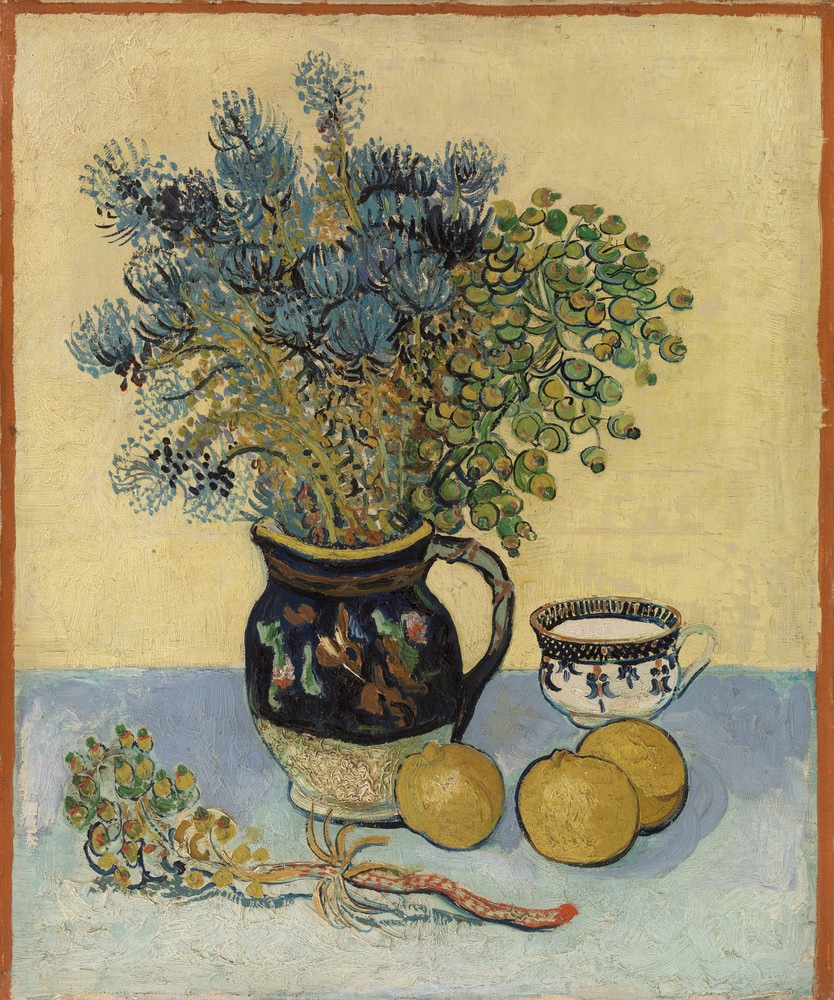
And finally, why did I choose a Van Gogh still life to illustrate this article. Because I particularly like this painting. I like the way it is a typical still life kitchen scene with jug, cup and some lemons. But the jug contains a profusion of flowers instead of milk. The lemons seem soft and shapeless as if they are on the turn. A sprig has either fallen out of the packed flower display, or is waiting to be included in the arrangement. There is a great deal of movement in this still life. It displays beautiful flowers in what we might think of as a utilitarian container not apparently meant for flowers. I thought this fitting for Sarah Winman’s book.

Titus Groan Meets Hill Street Blues

Titus Groan is a novel by Mervyn Peake published in 1946. It tells the story of Gormenghast Castle, the ancient seat of the Earls of Groan. Titus has just been born, son of Sepulchrave, seventy sixth Earl of Groan. Does this event mark a new beginning and direction, or another heavy link in the chain of unending Groans? This question looms over the rest of the book. Do people control their lives? Are they playing out a role, decided by fate, or ancient tradition? The Groan royal family includes a pair of twins – twins serving as a reminder that our decisions might not seem so much ours after all, when someone else who looks just like us ‘decides’ to do the same thing as we do, at the same time. Titus Groan reminded me of Hamlet – set in a castle, dealing with weighty themes of destiny and freewill. And as in Hamlet, there is a schemer character, disguising his own self-interested plans as twists of fate.

On a different note, the book also reminded me of something I happened to stumble upon while reading the book – the 1980s police drama Hill Street Blues, of all things. A picture of the cast appeared on my Facebook feed. Facebook knows I am of a certain age, and has a plan lying behind the apparently random appearance of photos depicting the cast of 1980s police shows. I went to YouTube and watched the famous opening sequence. Just as in 1981, a tired woman’s voice says, “Dispatch, armed robbery in progress, C-Surplus store, corner of People’s Drive…”

A police car emerges from behind a garage door, before sliding off through slushy snow on another cold morning. Then you get that music by Mike Post, reflective, sad, rising to a sigh of steady violins. Another morning, always the same with every episode, the same armed robbery, the same slush and cold, which somehow remains reliable, peaceful and reassuring. I reminisced for half an hour – the show was on during my university years. I bought a book about it in the university bookshop. Anyway, I had some reading to do. Focus Martin. I went back to Titus Groan, and felt in an odd way that my digression hadn’t taken me far from Gormenghast Castle after all.

My Friends by Hisham Matar – Democracy is a slow process of stumbling to the right decision instead of going straight forward to the wrong one.

My Friends, published 2024, is a novel by Hisham Matar, long-listed for the Booker Prize.

Khaled, the narrator, is not an action hero by any stretch of the imagination. He’s a quiet, intellectual young man, a Libyan student studying English at Edinburgh University in the mid 1980s. At that time I was a similarly less-than-heroic student studying English at Warwick. Sometimes people would knock at the door of my campus study bedroom, asking me to go on demos. I would politely decline. Khaled’s instinct would be to do the same. However, in April 1984, his more radical friend, Mustafa, persuades him to attend a demonstration outside the Libyan embassy in St James’s Square, London. You can see why Khaled might take a deep breath and decide that attending one demo might be the decent thing to do, given the recent execution of student activists by the Libyan government.

Inexperienced in the ways of protests against dictatorial regimes, Khaled and Mustafa get to London and realise they need some kind of face covering to protect their identities from Libyan spotters. After locating a couple of black polyester balaclavas in a sex shop, they make their way to St James’s Square. Khaled plans to just do a quick bit of shouting, before slipping away to find lunch in China Town.

He doesn’t get to do this because someone inside the embassy points a machine gun out of a window and starts shooting, wounding eleven protesters and killing a young police woman called Yvonne Fletcher. I remember watching reports on the news.

This part of the book is very dramatic, particularly scenes at Westminster Hospital where a badly injured Khaled is taken. His life changes from this point on. He is a marked man and cannot go home to Libya. Politics is not some student game anymore. How will Khaled and his friends react? What form will their ‘growing up’ now take?

Responses vary between joining armed militias, to vaguely hoping that if only people would read more books and let things work out for themselves, life would go better. This all takes place against the backdrop of London, presented as a natural place of exile, a place of buses to Marble Arch, of fog and cosy restaurants.

My Friends does not have a prescription for good government, or how we should respond to bad government. What it does is personify different prescriptions in the characters of a group of devoted friends, who are both uneasy, and deeply admiring, of each other. The relationship is the thing, rather than one of them winning. Ultimately, however, I would point out that the narrator of this novel, the hero if you like, is the one who lives a bookish life in London. He is the novel’s quiet central government. Chaos rages around him. And if there is a lesson in My Friends, it might have something to do with that.

Headshot by Rita Bullwinkel – Boxing as a Girls’ Clapping Game

Headshot is a novel by Rita Bullwinkel published in 2024, long listed for the Booker Prize. The action takes place over two days at Bob’s Boxing Palace in Reno Nevada, where the eight best under-eighteen girl boxers in America take part in the Daughters of America Cup.

Already my description is a bit off, which reflects how tricky this novel is to pin down. It’s not really confined to two days. The disembodied narrative spins off into past and future. We find out about the competitors’ childhoods and later lives.

This is a book about boxing. The girls are clearly defined as individual combatants. But the book really gets interesting in using boxing as an unexpected metaphor for togetherness, and feminine togetherness at that. Boxing is a sport where you look your opponent in the eye. There is no sense of running your own race in boxing. You are in it with your opponent. From that sense of robust sharing, there is a comprehensive breaking down of demarcations, categories, individuality, to explore a shared experience. Boxing is paralleled with girls’ clapping games, hair braiding. It’s cleverly done, using a tough sporting event in a grubby boxing venue to explore the boxers’ lives, and then life in general as a battle that is also, somehow, a collaboration.

I came out of the book with an odd feeling of reassurance that people’s endless capacity to fight is combined with an endless capacity to work together. In the wider boxing match of life, which all the girls have come from and will return to, there is the same opportunity. I admired the book. It is both a challenging punch in the eye with its originality, while still capable of putting a friendly arm around your shoulder. Rita Bullwinkel is a professor of literature at Leipzig University – and maybe this sense of challenge combined with collaborative help is a good one to describe teaching. I hope I was a good student in this boxing class.

Glorious Exploits by Ferdia Lennon – Forgiving the Unforgivable

Glorious Exploits is a novel by Ferdia Lennon, published in January 2024. It is set in the aftermath of Athens’ invasion of Sicily in 412 BC, during the Peloponnesian War. Defeated Athenian soldiers have been rounded up and herded into quarries – concentration camps essentially – near the city of Syracuse. Two local, unemployed potters, fans of Athenian theatre, get it into their heads to find actors amongst the prisoners who would be willing to stage a production of two plays by Euripides. The story follows their efforts to stage the plays, and ultimately find friendship with the enemy.

Through the lens of the present day, past culture often takes on a shiny polish, becoming the sort of thing studied in schools and universities. In their own times, however, posh classics were still in the category of show business. How to recreate that more authentic, contemporary feel? Glorious Exploits takes the initially surprising decision to have its characters speak in Irish vernacular, where good things are ‘cracker’. After about a chapter I just accepted that Fifth Century BC Syracuse was like an episode of Derry Girls. It worked very nicely in setting the right tone, a way of correcting the focus of that lens of the present.

So, the two potters, after some ups and downs, actually manage to stage Euripides’ Medea, and The Trojan Women in an improvised quarry theatre. Inevitably, in working together, Sicilians and Athenians gain an understanding of each other.

And this is where the Euripides plays themselves become interesting. While the process of staging the plays fosters a feeling of forgiveness and togetherness between the Athenians and Sicilians involved, the plays themselves are definitely not fluffy. Euripides is not the sort of writer to give advice about being kind. In fact, his plays show people at their most unforgiving. In Medea, the hero Jason comes back from an adventurous trip having won the Golden Fleece, a success that owes much to his gifted wife Medea. And how does he thank her? By planning to divorce her and marry a younger woman. Medea is not impressed and plots terrible revenge. She murders Jason’s girlfriend, the girlfriend’s father, and even her own children, as a way of hurting Jason in the most profound way possible. The same pitilessness is evident in the next play on this dark double bill, The Trojan Women. After conquering Troy, victorious Agamemnon takes Cassandra home as his trophy wife. His old wife Clytemnestra responds by murdering both her old husband and his new wife.

These are plays of vengeance not understanding. But that might be the point. During the performance we see the audience encouraged to see situations from the point of view of the most entrenched positions.

One moment I’m with Jason, the next Medea, and it swings this way and that, like the battle in the great harbour…’

So we get an unvarnished view of the reality of conflict, where there is no way the combatants will reconcile. And yet looking on, it’s possible to see both sides. Seeing both sides is described in terms of a battle. Maybe the final tragedy is that understanding doesn’t necessarily bring peace. When a wronged Sicilian takes his revenge on Athenians, our understanding of his motivations does not stop him lashing out.

Glorious Exploits is funny, hard edged, and taking its lead from Euripides, relentlessly unsentimental. It does not promise that people will get on and be nice. But like Euripides it does suggest that understanding can be present in the bitterest of divides. A play is like a battle to understand, the argument swinging from one side to the other. If we are destined to face battles, the battle to understand is the best one to fight.

Housekeeping by Marilynne Robinson – Wherever I Lay My Hat

When I was a young writer starting out, I read The Writer’s Journey by Christopher Vogler, which made a significant impression on me. Based on the work of Karl Jung and Joseph Campbell, the book suggests that all stories derive from what it calls the Hero’s Journey, a kind of ancient training for young men, who will soon have to leave the camp fire and venture forth in search of resources, territory and discovery. This idea seemed compelling to me. In fact, once you see the journey laid out in its various traditional stages, it’s difficult to unsee.

Early on in his book, Vogler describes some objections to the idea of the Hero’s Journey. One of these is the suggestion that it is unsuited to the experience of women, who are perhaps less likely than men to move between one external goal and another in a linear way. Marilynne Robinson’s novel Housekeeping might serve as an illustration of this objection, because apparently it’s about staying home in a women-only household. How will a story work in that scenario?

Fittingly, we start with an accident that gets rid of a man. Edmund Foster lives in the remote town of Fingerbone, Idaho, a restless soul, who takes a job working on the railways. He dies when his train crashes from a bridge into the vast lake beside Fingerbone. With male influence removed at this early stage, direction seems to disappear from the lives of the wife and three daughters he leaves behind.

‘With him gone, they were cut free from the troublesome possibility of success, recognition, advancement. They had no reason to look forward, nothing to regret. Their lives spun off the tilting world like thread off a spindle, breakfast time, supper time, lilac time, apple time.’

With men out of the picture, the story confines itself to home and domesticity. However, we are not in the situation suggested by Christopher Vogler of female-being opposed to male-doing. Sylvia Foster, might lose her sense of direction after the death of her husband, but she also demonstrates that men don’t have a monopoly on seeing life in simplistic journey terms.

‘… she conceived of life as a road down which one travelled, an easy enough road through a broad country, and that one’s destination was there from the very beginning,’

Sylvia, after a few years of routine, man-free housekeeping, finds that her three daughters leave home. After a few more years, middle girl, Helen returns to Fingerbone with two daughters, Lucille, and Ruth – the story’s narrator. But Helen only drops off the girls at grandma’s house, before promptly committing suicide by driving into the lake, leaving Sylvia to look after her granddaughters. When Sylvia herself dies, Lucille and Ruth are looked after first by Sylvia’s stick-in-the-mud sisters-in-law, and then by her youngest daughter Sylvie, who returns to Fingerbone after living a rootless, hobo life, drifting around America.

We now seem to be asked a question – is life drifting from day to day at home in Fingerbone, really any different from an itinerant life, wandering from town to town by jumping on freight trains? Neither has any sense of direction. Sylvie is a ‘transient’ who never really settles in Fingerbone. Nevertheless, it is repeatedly made clear that Fingerbone is itself transient, a town that floods yearly, burns down occasionally, prey to all kinds of natural and economic hazards, enduring only due to the inertia of its unadventurous residents.

So, going back to the Hero’s Journey idea, in Housekeeping the experience of women who stay home overlaps with that of those who wander on endless journeys. I’m reminded of a song that was in the charts the week I myself left home, to go to university – Paul Young’s version of Wherever I Lay My Hat (That’s My Home).

I don’t know if Marilynne Robinson wrote this book to take on Joseph Campbell and his Hero idea. But in her essay collection, When I was a Child I Read Books, she does refer to Joseph Campbell, saying his scholarship ‘does not bear scrutiny.’ After reading Housekeeping it’s difficult to see much difference between getting out there and staying home. Both are equally non-linear experiences. This is a denial of the Hero’s Journey – though ironically, it could also be something of an ironic confirmation of its relevance. After all, Housekeeping is another book about journeys, even if they are contradictory, enigmatic, with a sense of being rather than doing.

Housekeeping was published in 1980, winning the PEN/Hemingway Award for best first novel, and now makes regular appearances on best novel lists.

Open City by Teju Cole – I Want To Be A Part Of It

Open City is a novel by Teju Cole, published in 2011.

I didn’t know what to expect when I borrowed Open City from the library. I’d discovered that Teju Cole was, amongst other things, a writing professor at Harvard. What would a book by a Harvard writing professor look like? Fancy, I thought. Would it be the kind of fancy that makes the reader feel fancy too, or the kind that makes them feel inadequate?

I started reading. Julius is a young doctor working in a New York psychiatric hospital. He has recently split up with his girlfriend. When off duty he listens to classical music, reads high-end literature, or goes for long walks in the streets of New York, visiting cultural sites. His mind drifts over his German/Nigerian childhood. He takes a holiday in Belgium with the vague hope of finding a lost grandmother. Returning to New York, he wanders round some more, gets mugged, learns something dark about his past, and goes to a concert.

Open City is not driven by plot – clearly. Instead it’s a book of thoughts and ideas, with its central preoccupation being identity. As a man who is part Nigerian, part German, Julius seems to be looking for a place in the world.

The book defines identity in all kinds of ways – by race, ethnic group, religion, age, even by the particular illnesses an individual might suffer. Actually, you could also define identity by the books you read. If reviews on Goodreads are anything to go by, people who like Teju Cole’s Open City form their own little tribe, cutting across international borders. This is one of a huge overlapping Venn diagram of identities. I put myself in the Open City admirers group. Others may not feel it’s a place for them, preferring cosy crime maybe. But then again, there will almost certainly be Open City readers and cosy crime readers who share the experience of having, for example, eczema. This is a book where we are all divided in some ways, while overlapping in others. I would suggest giving Open City a chance. It’s clever, but not in a way designed to make readers feel small. Yes there’s name dropping of European authors, and attendance at performances of Mahler symphonies given by the Berlin Philharmonic under Simon Rattle. But even if this is not apparently your thing, I think you will still find some common ground somewhere in Open City.

One last point. I enjoyed the way Cole set the story at a time when the world of books is changing. Julius goes to bookshops just before they go out of business – record shops too. This is the moment when the old analogue culture moves to digital. This shift serves to break up human contact, ending the physical experience of going to a shop with other people. There is a definite sense of loss. At the same time, there are new potentials for communication. Back in the heyday of bookshops this review would never have been written. I would have had to leave it to someone working for the Times Literary Supplement or The Guardian. Now anyone can put their review of Open City out there, and look to overlap with someone else’s literary Venn diagram.

My advice would be to consider joining the Open City tribe. In fact, in one way or another, you’re already a member