The Mechanical – what is freewill?

Mechanical Cover


The Mechanical by Ian Tregillis is an alternate history.  In seventeenth century Europe, the Dutch scientist Christiaan Huygens visits Isaac Newton in Cambridge, looks at his work on alchemy, and makes a massive breakthrough. The mysterious aim of alchemy, to win the ability to transmute matter and find a universal elixir of life, becomes a reality in the shape of clockwork robots imbued with the self-aware force of life.  To maintain control of this technology, Dutch clockmakers imbue their creations with a ferocious sense of obligation that demands absolute obedience through pain.  Using these robots Holland becomes the world’s leading power.  Only the French hold out in eastern Canada. The story then follows the fortunes of a rogue “clakker” robot who goes on the run after coming into possession of a mysterious lens, freeing him from his internal compulsions.

The story itself is rather James Bond in its feel. A French spymaster tries to help the freedom loving clakker.  Their efforts end up, as usual, in an underground lair, the setting for fighting and explosions.  Perhaps it is right that the story follows this highly conventional pattern, since it is really about how we might find freedom in a life that demands we follow a destined path.   While the clakkers have an overwhelming internal obligation to do their masters’ bidding, there are also suggestions that humans have obligations of their own built into them.  This human element of compulsion becomes overt when the Dutch secret police capture a priest, acting as a French spy.  They place clakker controls within his brain, and send him off against his will to spy on the French in Canada.  His only hope of escape is the lens in the possession of the rogue clakker.

The freedom-offering lens is the work of a Dutch contemporary of Huygens, philosopher and lens maker Baruch Spinoza.  Ironically, Spinoza’s reputation as a philosopher is based on his Ethics in which he argues that all human life is destined.  Famously in Ethics he says : ″the infant believes that it is by free will that it seeks the breast; the angry boy believes that by free will he wishes vengeance; the timid man thinks it is with free will he seeks flight; the drunkard believes that by a free command of his mind he speaks the things which when sober he wishes he had left unsaid. … All believe that they speak by a free command of the mind, whilst, in truth, they have no power to restrain the impulse which they have to speak.”

Given all this, why is it a lens ground by Spinoza offers the chance of freedom?  Perhaps the answer lies in Spinoza’s idea that we can become aware of the compulsions that drive us.  We can detach emotions from their external cause and in this way master them.

Whatever conclusion you might come to, the important thing is that Ian Tregellis gets you thinking.  The book encourages a reader to explore all kinds of things.  I was off reading about Huygens, Spinoza, Descartes and Newton.  This is a very interesting book.  I recommend it.


The Multinational Crew of HMS Victory

Victory_Flag_Message

England may have expected, but it wasn’t just England who answered the call.

The crew of HMS Victory at the Battle of Trafalgar by nationality from Janes’s Naval History – 441 English, 64 Scots, 63 Irish, 18 Welsh, 22 Americans, 7 Dutch, 6 Swedes, 4 Italians, 4 Maltese, 3 Frenchmen, 3 Norwegians, 3 Germans, 3 Shetlanders, 2 Swiss, 2 Channel Islanders, 2 Portuguese, 2 Danes, 1 Russian, 1 African, 1 Manxman, and 9 men from the West Indies. So that’s a third of the crew of the Victory not classified as English.

When England expected every man to do his duty, Europe helped

England_Expects

“England expects” flag signal on the rigging of HMS Victory in 2005

This week there will be many people arguing over Britain’s past and future. It is worth bearing in mind that if Britain has a past as a powerful country, then that would not have been possible without European influence. I am reading Benjamin Disraeli’s book Sybil at the moment, and Disraeli reminded me of how the introduction of Dutch methods of finance underpinned British power in the eighteenth and nineteenth centuries. These ideas were introduced to Britain when Parliament arranged for Dutch monarch William of Orange to replace James II in 1688. Disraeli was not approving of Dutch finance, since the acceptance of national debt dates from that time. But all the power that the British empire wielded at its peak could not have happened without Dutch financial ideas.

The economic historian P.G.M. Dickinson writes of the crucial advantage of public borrowing during the Napoleonic Wars: “More important even than alliances… was the system of public borrowing… which enabled England to spend on war out of all proportion to its tax revenue, and then throw into the struggle with France and its allies the decisive margin in ships and men…” Acceptance of debt meant that Britain could outspend France, which was a bigger and essentially richer country. And it was the Dutch with their history of banking and commerce which allowed Britain to do this. These advantages allowed Britain to quickly recover from the huge setback of losing the American colonies in 1781 and become the world’s most powerful country up until the end of the nineteenth century. So even when Britain was at its most dominant, it is salutary to remember that this position would not have been possible without a Dutch king who took the throne in 1688.

Was Plato a Sociopath?

Republic cover

The Republic is Plato’s famous fourth century BC description of the ultimate just society.

I have just finished this book, and I loathed it.

The Republic begins by asking how we can identify morality. Plato sees morality as a set of rules. He suggests putting individual desires second to general interests, fostering unity, and playing your part in a society where there is rigid specialisation of roles. Plato, however, has no conception that morality might have less to do with rules and more to do with empathy.  Morality is actually an extension of the ability to understand how others are feeling, which tends to count against actions that are selfish or hurtful. We also call empathy “having a conscience”. The thing is Plato shows no ability to understand what other people are feeling.

In the sections where he condemns poetry, for example, it is the sense of empathy that really irritates Plato.  Reading Homer, or any other writer, he is appalled when he is made to feel the pain of others:

“When Homer or another tragedian represents the grief of one of the heroes, they have him deliver a lengthy speech of lamentation or even have him sing a dirge and beat his breast; and when we listen to all this, even the best of us, as I’m sure you’re aware, feels pleasure. We surrender ourselves, let ourselves be carried along, and share the hero’s pain; and then we enthuse about the skill of any poet who makes us feel particularly strong feelings… However, you also appreciate that when we’re afflicted by trouble in our own lives, then we take pride in the opposite—in our ability to endure pain without being upset. We think that this is manly behaviour, and that only women behave in the way we were sanctioning earlier… So,’ I said, ‘instead of being repulsed by the sight of the kind of person we’d regret and deplore being ourselves, we enjoy the spectacle and sanction it. Is this a proper way to behave?”

This is typical of much of Plato’s criticism of literature, which he sees only in terms of false representation of the world, rather than in terms of communication between people.

From this basic lack of empathy derives all the things I hated about The Republic.  Plato is able to dismiss the little people in society, lie to them about why exactly they have to accept their rigid role in life, let babies die if they are judged unworthy, let sick workers die for want of medical attention because if they are that sick they are better off dead. He can suggest that no woman keep her own child, or that people do not form stable marriages with each other. Plato had no idea how people would be feeling in all these situations, and therefore is immoral in the way he talks about them. Plato is only interested in controlling people, not understanding them.

Some readers might say that at least Plato understood the pain of women, when he famously argues that women should play an equal role alongside men in society. But coming to this conclusion in no way involved Plato imagining himself as a woman, and feeling their frustration. Instead, he looks at female dogs, sees them making good guard dogs, and thinks that society would be more efficient if it were to treat human females in the same way.

Today we use the term sociopath to describe an individual who cannot feel empathy.  These people are without conscience, live only to manipulate others, and are adept at hiding their nature. What better place for a sociopath to hide than in a book on morality, which describes all kinds of ways in which people can be manipulated in society, from breaking up any possibility of power based on families, to brainwashing from an early age, to creating myths persuading them to accept their allotted role in life? The Republic could be a handbook for totalitarian regimes everywhere.

That’s why I loathed The Republic.
Politics lessons from Claudius


Claudius crop

Robert Graves recreates the life of the Roman Emperor Claudius, as if Claudius were writing his biography in secret.  The first part of his story, I Claudius, follows events up until the fearful and comic moment when, against all expectations, Claudius, the stutterer, the fool, the gauche academic, becomes emperor of the Roman Empire.  Claudius the God describes his subsequent years as emperor.  If Claudius could have chosen his life, he would have been a historian working quietly in some pleasant university.  Through Graves’ imagination, Claudius’s subject becomes himself, and the way people organise leadership.  In I Claudius, we see the dark consequences of deciding that the messy business of life is all too much, and that instead of frustrating debate, disagreement, and compromise, why not throw all of that out of the window and get yourself a tyrant?  In some of the most charming sections of Claudius the God, we actually see the advantages of this plan.  Claudius is a good emperor who uses his power to defeat short-term self-interest and small mindedness.  Corn merchants, for example, object to plans to improve Rome’s harbour at Ostia, because a secure supply of corn coming in through a safer harbour might depress prices.  Claudius has the power to cut through all that and transform Ostia.  Sadly, at the end of the book, with the promise of Nero’s rule to come, we see that these advantages will be short-lived.  It is very difficult to get yourself a good tyrant, to find someone with the humility to see that power does not rest in themselves, but in the fear of others.

I loved the second book as much as the first.  Graves seems to get into Claudius’s mind so successfully, that a reader sees the world from a completely different viewpoint.  We see Britain as a backward place, where at a push some of the best men might make good coachmen.  And we see early Christianity as a confused mass of Life of Brian events, different people claiming to be messiahs, unexpected births in a down-at-heel Bethlehem inn, an earthquake moving a rock covering the entrance to a tomb, all somehow becoming the familiar story of Christianity we know today.

The story Claudius tells us is over two thousand years old, but we see our own world in it.  We see where our present situation evolved from, and realise that the dilemmas we face in selecting leaders remain strangely familiar.


The Three Lions of Europe

Three_Plantagenet_Lions

Britain’s association with Europe goes back much further than entry into the European Community in 1973. Ever since the climate improved enough to make Britain a place where anyone would want to live, there have been waves of migration from Europe. Following centuries of settlement by a range of European people, Britain became a province of the Roman empire, remaining so for about four hundred years, from AD43 to around 410AD. When the Romans left there was a period of chaos, which Scandinavian invasions in the ninth century helped to end, directly through imposed rule, or indirectly by providing the surviving English kings with a formidable enemy to unite against. Then in 1066 the Normans invaded, and Britain became a northern province of the Angevin Empire based on Normandy and areas of what is now western France. As time passed this empire suffered stresses and strains between its senior leaders, and was attacked by the kings of France. By the thirteenth century only the English rump of the Angevin Empire remained. England, led by kings such as Edward III and Henry V then spent a few centuries trying to recreate the old empire, a struggle which ironically is often told in terms of English patriotism. In 1485 Richard III, the last Plantagenet king, representing the line which once ruled the Angevin Empire, was killed at the Battle of Bosworth. This ended a period of 1400 years when Britain was either part of a European reality, or struggling to recreate it.

After 1485 there was a change. The Tudor monarchs, Henry VIII excepted, tended to look outside Europe for links that would help a small island nation find some influence in the world. These explorations would eventually lead to the period of the British Empire, which for a few hundred years in the eighteenth and nineteenth centuries allowed Britain to wield huge global influence. This brief, and historically anomalous time soon passed, ending with the Second World War. After that, with the Empire falling away, it would be natural that a small island on Europe’s northern flanks should look back towards a large neighbouring continent. It is historically incorrect to see Britain as an ancient island nation which only now is threatened by bureaucrats in Brussels. From an historical point of view, Britain as part of Europe is the more normal state of affairs.

New Writing About Old Mars


Old Mars
Old Mars is a collection of short stories, inspired by the pre-Mariner probe tradition of science fiction writing about Mars. There is a great introduction by George R.R. Martin about his youthful admiration for fanciful Martian tales. Then comes a selection of stories reflecting the influence of various twentieth century science fiction writers. Allen M. Steele, for example, sets the first story in a desert not unlike that of Nevada, complete with an Edgar Rice Burroughs themed resort. This resort is a reminder that we like to create fantasy worlds on Earth. So why not continue to create them on Mars.

I also enjoyed The Wreck of the Mars Adventure, which imagines seventeenth century pirate William Kidd sailing to Mars with the help of a scientist of the time. Kidd’s flying sailing ship had me thinking about how difficult it is to imagine the future. We usually only see what is to come in terms of technologies we actually live with.

The final story in the book was my favourite. Ian Macdonald imagines a future where Earth strikes back at the Martians of H.G. Wells who invaded west London in their tripod machines. The story follows a singer of popular song and light opera, his career on the decline, who finds himself in a concert party entertaining troops on Mars.

However, I didn’t find all of the stories so successful. King of the Cheap Romance was shoddily written. I don’t know if this was an ironic reflection on the poor standards of cheap romance writing. There is shoddy writing in the history of Mars literature. John Carter of Mars, listed as by Edgar Rice Burroughs, (actually by his son) uses a style known politely as “juvenile.” Joe R. Lansdale appears to write King of the Cheap Romance in the same style, and a sense of irony was not enough to get me through it.

Overall, I would recommend this book. It’s a good way to introduce yourself to authors you might want to explore further, and Ian Macdonald’s concert party story makes the book worthwhile on its own.

Should a novelist be interested in economics?

Bank_Of_England


When I was at university in the 1980s, I wrote an essay on the American writer David Henry Thoreau, and said he was interested in economics. My tutor’s reaction is still clear in my memory: “Literature is not about economics!” he declared. This was quite shocking. I thought literature could be about anything. But no. I guess it had to be about star-crossed lovers.  The fact is, however, as Alfred Marshall wrote: “Economics is a study of mankind in the ordinary business of life”. Economics, seemingly an esoteric dark art confined to forbidding institutions is really about what we do everyday; going to work, or being unemployed, going out shopping, or staying in and watching television. Economics like literature, can be about anything.


Money is the common currency, something virtually all of us have, and something which divides us. People are divided by how much they earn. This seeming inevitability hasn’t always been the case. In hunter gatherer societies surviving today, there does not seem to be a tendency to gather private property. Resources are more likely to be shared out, rather than hoarded by a few individuals. Both John E. Pffeifer in The Creative Explosion and James Shreeve in The Neandertal Enigma begin their explanations of human social development by pointing out that hunter gatherer societies rarely have a leader. Modern Kalahari Bushmen have no specific leader, and train their children from an early age to share all they have with each other. Charles Darwin remarked on the same social arrangement in the natives of Tierra del Fuego, during his famous voyage on the Beagle. He met the Fuegians on a freezing, rainy day, and wondered at their condition as rain ran over their entirely naked bodies. “In Tierra del Fuego, until some chief shall arise with power sufficient to secure any acquired advantages, such as domesticated animals or other valuable presents, it seems scarcely possible that the political state of the country can be improved. At present, even a piece of cloth is torn into shreds and distributed; and no one individual becomes richer than another” (The Voyage of the Beagle P184). There is a sad truth in Darwin’s words. People aspire to nicer things, a better life. They look at other people and covet what they have. In this way, economies are driven forward. They depend fundamentally on some people having a great deal, and others having much less. But of course this division is never going to be stable. The fluctuating struggle between necessary social division and necessary reaction against such division is a fundamental aspect not just of economic history, but of history itself, and the literature which has been written by people living through it.

So, yes, its perfectly acceptable for novelists to be interested in economics.

The history of how we see ourselves

Femme_au_miroir

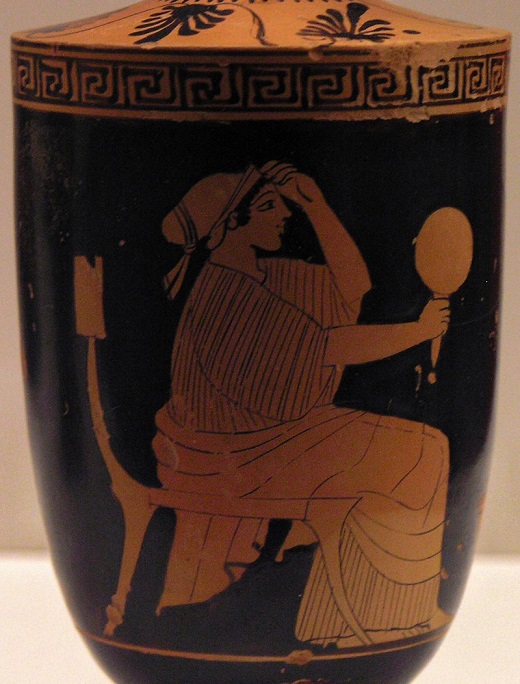
We take mirrors for granted today, but a reflective surface probably played a crucial role in the development of human self awareness. Obviously if you see an image of yourself, and realise that image is you, self awareness has been acheived. This could only have first happened when people looked into the water of ponds or gently flowing rivers. Not surprisingly springs, rivers, ponds and lakes have often been invested with spiritual significance. The huge Bronze Age monument at Flag Fen in Cambridgeshire, a ritual bridge structure across an area of water meadow, probably celebrated the reflective characteristics of water.

The earliest manufactured mirrors were made from obsidian, a rare, naturally reflective volcanic rock. Examples of obsidian mirrors have been found in the area of Anatolia in modern day Turkey, dating to around 6000BC. From 4000BC craftsmen in Mesopotamia were making polished copper mirrors. From this time onwards mirror manufacture continued as a highly expensive business, confining ownership of mirrors to the rich. It wasn’t until 1835 that the silvered glass mirror was invented by German chemist Justus Von Liebig, and mass production became possible. Today mirrors are everywhere. We brush our teeth, style hair, and squeeze spots in them. But mirrors were the first place where we became aware of ourselves, and are now used as a basic test of self-awareness in the animal kingdom. In 1970 the psychologist Gordon Gallup developed the Mirror Test to judge ability in self recognition. So far only humans and other great apes, dolphins, orcas, European magpies, and a single Asiatic elephant have passed the mirror test.

So that mirror in your bathroom was the place humanity first became aware of themselves, and where we discovered we are not alone in this ability.

What can the Ramones tell us about elections?


Ramones_-_Ramones_cover

There are many elections to think about at the moment – London elections for mayor, local elections, elections for the U.S. president. In any election “change” is a big thing. Anyone who offers it seems exciting. Anyone who says “I can offer you more of what has gone before,” doesn’t come over as quite so compelling. That being said, it is obvious that people are also wary of uncertainty, and fond of the familiar. Ideally then, change should be a continuation of the past dressed up as something new. I was thinking about this earlier this week on my latest stop on a journey through the Rolling Stone Magazine Top 500 albums of all time. I had reached 106, Rocket to Russia by the Ramones. The notes on Apple Music told me that the Ramones were the first punk band, which meant they took the bare essentials of pop music – four chords, a catchy melody and cleverly inane lyrics – and speeded up the tempo. In this way, they could go back to the pop of the late 50s and early 60s, and still sound revolutionary. They could wear the torn blue jeans and leather jackets of late 1950s greaser rockers and yet still have the sound for a radical new generation. Strange as it may seem the Ramones managed the trick used by successful politicians, to offer something old dressed up as something new. Still you won’t have a politician sing:

You think I’m real cute, but who’s gonna bring home the loot

Make up your mind about, hope you don’t doubt

That I can’t give you anything.