When you read a book, if the author is any good, you feel for the characters living in its pages. A reader empathises with them, worries about them, and follows their story. Words on a page can create this real emotional attachment.
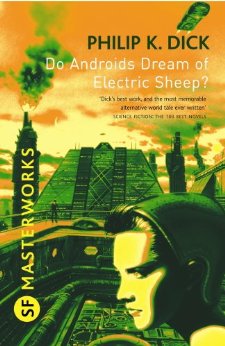
So if bits of the alphabet carefully strung into sentences can create living people, it’s not a big step to imagine androids who have a sense of life to them. This is the theme of Do Androids Dream of Electric Sheep? It describes a post-apocalyptic world where usually subservient androids occasionally go rogue and try to make an independent life for themselves. Bounty hunters have the job of hunting down renegades and putting them out of action. Their task is complicated by the fact that artificial life forms are growing in sophistication, looking and acting very much like real people. So a test is required to differentiate one from the other, a test based on the idea that humans demonstrate a capacity for empathy, which is missing in an android.
One of the great achievements of the book is to create believable artificial characters, robots with their own charm and personality. I loved the way one of the lady androids says “pardon” when confused, while her “husband” is a gauche fellow who always puts too much force into closing doors. They also have a kind of childish cruelty, giving a jagged edge to their charm. That was how the androids struck me, as children trying to work out how to live in the world. They lack empathy in the same way that young children sometimes lack empathy. But I got the feeling that given the chance, they might develop this quality, as most, if not all, humans do.
The overall irony is, human or android, all of Philip K. Dick’s characters are built out of words, and in that sense are equally fake and equally real. This is a book which encourages a reader to take a more open minded view of what is real and what is pretend, of what matters and what can be dismissed as unimportant.
Alison Winter’s book Memory, Fragments of a Modern History.
I read this book for two reasons. First, I am writing a character who has memory problems. In his futuristic story, he has treatment with implants of data. I wanted some background for that. Second, I am interested in history, which always seems in a process of constant rewriting to suit the needs of the present. I wondered if there were any similarities with personal memory.
Well, for my character, I gained an understanding of how malleable memory is. Clearly, there is already a science of memory manipulation, whether memories are implanted, boosted, or dampened down with drugs like propranolol. As for my question about history, influential writers such as Frederick Bartlett would say, yes, personal memory is like the broader memory of history. There is a constant rewriting going on, changing our perspective on the past in light of later events. A few days ago I happened to watch a video of Apple’s Steve Jobs giving a speech at a Stanford graduation ceremony. He described various episodes in his life, which were painful or chaotic at the time, which he felt made sense later on. He “joined the dots going backwards”. Personal memory and history both do this. It is quite something to see the great shared memory of humanity working in the same way as you or me thinking about our pasts and trying to join our own dots.
The history of the Labour Party could be seen as a continual search for someone like Jeremy Corbyn. The search began in the earliest days of the party, as a hunt for the first genuine Labour member of Parliament. For many years, two miners were pushed into this role – Alexander Macdonald, leader of the Lanarkshire miners, and John Burt, secretary of the Northumberland miners. These two men entered Parliament in the 1870s. Up until 1920, Alexander Macdonald – a remarkable man who even with the demands of a mining job gained a degree at Glasgow University – was named by Labour Party historians as “Britain’s first Labour member” (see The Book Of The Labour Party, ed H. Tracey Vol 32 P16). The problem, as time went on, was the willingness of Macdonald and Burt to enter into alliances with the Liberals to support their position, which eventually had historians ousting them as Labour Party founders.
With Macdonald and Burt no longer fitting the bill, Labour chroniclers looked for a different founding father. For a while they tended to settle on a miners’ union representative and journalist named Keir Hardie who entered Parliament in 1892. Hardie won his time as Labour’s apparent founder because, like Jeremy Corbyn, he was not a political animal at all. He refused to enter into the alliances his colleagues felt necessary. He stood alone as a party of one. If you can call one man the Labour Party, then Keir Hardie may have been its beginning. Inevitably, however, even the most enthusiastic historians realised that Hardie could not realistically be the creator of any party, because he simply was not a party man. Historians were then forced back into the world of fudge and compromise. Keir Hardie was quietly put to one side, and the 1906 election became the defining moment for Labour, when 29 Labour Representation Committee MPs were returned. The difficulty with this apparent breakthrough, was the fact that Labour still struggled to maintain distinctive independence from the Liberals. All Labour MPs were only elected because of local Liberal associations deciding not to put a candidate up against the Labour candidate and thereby splitting the non-Conservative vote. Labour, for all intents and purposes was still a wing of the Liberal Party.
So the search for a defining figure went on, continuing through the 1920s and early 1930s, when Labour actually had its first prime minister in James Ramsey MacDonald. Poor Ramsey MacDonald found himself in his first term in 1924 leading a minority government kept in power for ten turbulent months by an alliance with the Liberals. Things became even worse in 1931 when a short lived Labour government fell and MacDonald was forced into the leadership of a coalition which included the Conservatives! This accommodation of course did not fit with the vision of Labour purity, which left the first Labour prime minister – another remarkable man – a maligned figure for many in the party. So once more the endless quest continued, as it does to this day. In the end, however, it seems that the Labour party’s almost religiously inspired search for a divinely unsullied leader, does not have much to do with the reality of politics.
So, Beyoncé’s song I Was Here, written by Dianne Warren in the aftermath of the 9/11 attacks on New York fifteen years ago…
The song has a circularity. Someone appears to be looking back on great achievements, while also feeling that their success lies somewhere in the future.
Perhaps the spirit of the song lies in that grammatically beguiling line “I did, I’ve done, everything that I wanted.” “I did, I’ve done” recurs throughout the song as a kind of chorus. I did and I’ve done are not two ways of saying the same thing. I did is the past perfect, used to talk about specific things in the past. “I did a number of great things.” A list of achievements could then follow, detailed on a CV. But “I have done” is a construction known as the present perfect, used to talk about experiences without saying precisely when they happened, or even what they were: “I have done some great things,” said with a faraway look in the eye. You get the sense that in summing up the significance of your life, any specific experience starts to become problematic. If you’re a singer like Beyoncé, do you point to some particular song you sang, even though songs become unfashionable, and some people don’t think pop songs are worth much anyway. Somehow, specific claims to fame fail to measure up. In their place comes a vaguer yearning for distinction. In fact, the idea of achievement becomes so vague that you get the line “I want to say that I lived each day until I die.” Well you could say everyone manages that. In place of the self-aggrandising song of a famous singer wallowing in their greatness you get a much more humane reflection on how relative the idea of achievement is. Even the humblest of people fulfil the hope of living each day until they die.
I Was Here is the song in which a celebrity culture reflected on itself and saw the bigger picture.
As a footnote, the music of I Was Here is in E minor, one of the most frequently used keys in pop music, since it suits the guitar very well. Building on this, the song uses a variation of one of the most familiar chord progressions in popular music, known as the 50s Progresson, so-called because it was widely used in the 1950s and 1960s. The 50s Progression is G-Em-C-D. The chord pattern for I Was Here is Em-C-D-Dsus-Em-C-Em-C. The suspended D chord, or Dsus, is another familiar feature of pop music. Technicalities aside, the point is I Was Here is quintessential pop music, using archetypal patterns familiar to everyone. If there is something special here, it is a quality of the widest range.
(Thanks to Rob for recommending this song to me)
I wanna leave my footprint on the sands of timeKnow there was something that,
Meant something that I left behind
When I leave this world, I’ll leave no regrets,
Leave something to remember, so they won’t forget
I was here
I lived, I loved
I was here
I did, I’ve done, everything that I wanted
And it was more than I thought it would be
I will leave my mark so everyone will know
I was here
I want to say I lived each day, until I die
And know that I meant something in somebody’s life
The hearts I have touched will be the proof that I leave
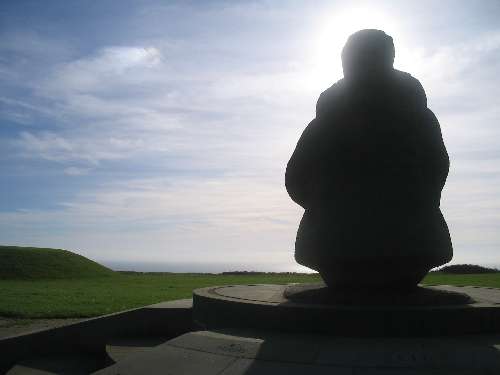
Battle of Britain Day, 15th September, commemorates the most intense day in the aerial battle over Britain in the summer of 1940. A memorial to pilots who fought in the Battle of Britain has been built at Capel le Ferne near Folkestone in Kent, an area where a great deal of heavy fighting took place in the skies overhead. There is a visitors’ centre, a Spitfire and a Hurricane aircraft, a flag mast which stood at Biggin Hill airfield during the battle, and the memorial itself, which consists of a huge representation of a propeller laid out in the grass, with a statue of a young pilot in the middle looking out to sea. I found walking around the memorial a moving experience. The pilot looks reflective and peaceful, as though it’s all over now and he can sit back and think about the past. There is also a sense, however, that he is still watching the sky for enemy aircraft. He is in full flight kit, ready to go. If the call came he would jump up and run to the Spitfire parked outside the visitors’ centre where people are having cups of tea. This is a thoughtful memorial, fittingly reflective, with an immediacy which suggests the atmosphere of those months in the summer of 1940. The memorial is one of tranquility, and yet there is still a feeling that any moment now…
The overriding impression, however, is the peaceful one. Some people, I fear, now scan the skies for illusory enemies. It is useful to reiterate following Battle of Britain day, that many of the pilots who flew with the RAF in 1940 were Europeans. It is shameful that Poles find themselves the victims of attacks since the European referendum, when Polish pilots played a vital role in helping win the battle. There might not have been a Britain to take a vote on European membership if it hadn’t been for Polish, Czech, Belgian and French pilots. We assume the pilot sitting at Capel le Ferne is British, when actually he could be Polish. We should remember that.
I visited Whitby Abbey this summer, and found a group of youngsters willing to dress up in many layers of black in thirty degree heat. They were paying homage to Bram Stoker’s Dracula which has scenes set at the Abbey. Admiring such commitment I read the book, and found myself introduced to a very proper Victorian gentleman named Jonathan Harker. As he travels east across Europe, he notices the trains get later and later. He can’t even imagine what the trains are like in China. It is a bit of a shock, therefore, when our conventional Englishman falls into the hands of a vampire living in a brooding castle.
Meanwhile, back in England Mr Harker’s fiancé is a Victorian stereotype of what women should be. Mina does her best to live up to this crazy ideal. She looks after her traumatised husband, following his escape from Dracula, and cleverly takes disparate records of vampire sightings, and puts them together to produce a coherent picture of what’s going on. But despite this contribution, her husband, and his group of male vampire-fighting vigilantes, announce in the most honourable of terms that a weak woman can have no part in fighting the enemy. Excluded from events, kept in the dark for her own peace of mind, Mina finds it difficult to sleep, no doubt the result of a suppressed sense of injustice. She allows the men to offer her a sleeping draught to help deal with nervous insomnia. Tellingly, it is while she is vulnerable, sleeping her drugged sleep, that a vengeful Dracula arrives in her bedroom.
Bram Stoker quietly pulls apart the apparent morality of his society, and shows how ordinary, proper life can actually push people into the land of the living dead. This was the aspect of Dracula I admired, equivalent to that modern Shaun of the Dead irony, where zombies invade an English suburb populated by people who are pretty much zombies anyway. Bram Stoker’s sentimentality is cloying at times, particularly in the second half, but thankfully there is always that undercurrent of satire, showing that Dracula’s castle isn’t so far from the Home Counties.
The Bram Stoker fans I met this summer were from Birmingham. They looked great and kindly allowed me to take a few photos.
This time last year I took out a subscription to Apple Music. I then worked my way through Rolling Stone Magazine’s Top 500 Albums Of All Time, finally getting to their number 1 album, Sergeant Pepper’s Lonely Hearts Club Band a few weeks ago.
The fact that I could make this musical odyssey – or odessey as the Zombies would have it – really brought home to me how much has changed in the way we access music. The advent of streamed music ranks up there with the shift represented by the development of records in the early twentieth century. After growing up with LPs, cassette tapes and CDs, the ability to listen to hundreds of albums without taking out a second mortgage – and without covering my bedroom walls in shelving – was a revelation.
So as a memento to my long musical journey here is a list of sixty tracks that I was glad to discover.
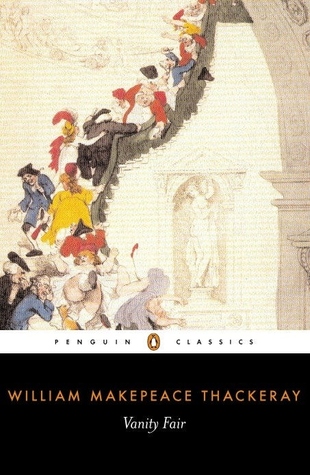
I finished Vanity Fair last night at about 1am, getting to the last page in a state of shock. This morning I wrote the following review for Goodreads.
Novels originally developed from morality tracts designed to teach readers right from wrong. In its own beautifully twisted way, Vanity Fair follows in this tradition. The title of the book derives from Bunyan’s Pilgrim’s Progress, an allegorical Christian journey leading from worldly sin to heavenly virtue. The difference with Vanity Fair is that when readers take its moral journey, they climb aboard a white knuckle roller coaster, with crazy loops showing up where down should be. The story’s virtuous characters find their good intentions leading to bad ends, while the vices of darker characters can ironically work to bring about good outcomes. Make no mistake, this novel is unflinching. People of a sentimental bent may feel that everyone always deserves the kindness of a second or third chance. Well if you think that, read Vanity Fair. The portrayal of Rebecca will put you right, and persuade you that occasionally a person comes along who is constitutionally without empathy, who enjoys manipulation for the sake of it, and is adept at hiding their nature by aping the appearance of respectability. To someone like Rebecca, the quality of seeing the best in everyone is a weakness to be exploited. Reader beware.
These books offer both practical advice, and a sense of friendship and support which is often lacking for a new writer. Happy reading.
How to Write a Damn Good Novel by James N. Frey
Wisecracking advice, support and tough love from one of America’s top writing teachers.
The First Five Pages by Noah Lukeman
A New York based literary agent explains the reasons why manuscripts are rejected, and offers solutions to common problems.
The Writer’s Journey by Christopher Vogler
A classic of the how-to-write genre. The Writer’s Journey is a study of mythological patterns informing story telling. Don’t expect advice on adverbs. This is a book about basic plot patterns, with reference to Hollywood films. It’s a fascinating book, interesting for what it tells you about the history of humanity, as well as for offering help with writing.
Sin and Syntax: How to Craft Wickedly Effective Prose by Constance Hale
This is the place for your adverbs and many other nuts and bolts. The seemingly dry subject of grammar is brought to life with great examples of fine writing. There is nothing boring about a book that helps you to aspire to such work.
Writing from the Inside Out: Transforming Your Psychological Blocks to Release the Writer Within by Dennis Palumbo
A lovely, warm book helping a writer to explore their life experience for the raw material of writing.
When I first arrived at university, innocent and impressionable, I talked to a glamorous third year who didn’t read much because she thought it would interfere with the uniqueness of her writing style. She also corrected the spelling of a note I put up in the kitchen.
I have to say, at that time it was easy to find myself persuaded by the girl’s view. Apart from the fact that she was attractive, a third year, and good at spelling, this was a stage in my writing career when admiring a book would immediately make me want to write in the style of its particular author. Perhaps literary quarantine was required. Maybe the usual advice for aspiring writers to read all the time wasn’t the right way to go. It didn’t, of course, take long to abandon this idea I enjoyed reading for one thing, and while I was willing to accept sacrifices to be a writer – career insecurity, lack of marriage offers and so on – giving up reading was a step too far. I also quickly came to the conclusion that it was precisely the wrong thing to do, because it’s a simple fact that a writer’s work is not unique. Each genre is like a great big soap opera with many writers contributing episodes. Individual writers might not all be together in a big room, but that doesn’t mean they aren’t working together. A successful writer is like a scientist who we associate with a breakthrough. This individual, for all their fame, in reality worked with many other people, both directly in their working lives, and indirectly in basing their work on the efforts of others who went before. People like a clear picture, a good story which focuses on an individual. But while Thomas Edison, for example, is meant to have invented all kinds of things, he was actually a man who ran research teams, the combined efforts of which became associated with the name Edison. Writing is like that. Finding your own voice does not involve avoiding other writers, but rather finding out how your voice fits in with them. People imagine a writer engaging in solo effort in their attic. In reality it’s more like singing in a choir, getting the odd solo if you’re lucky. At the minute I admit that I am part of the chorus. But no matter. The soloists depend on the chorus behind them, and one way or another, successful or unsuccessful, we are all part of that common effort. I will keep going, and if you’re a struggling writer I wish you the best. We’re all in it together.







 Writing And So On