
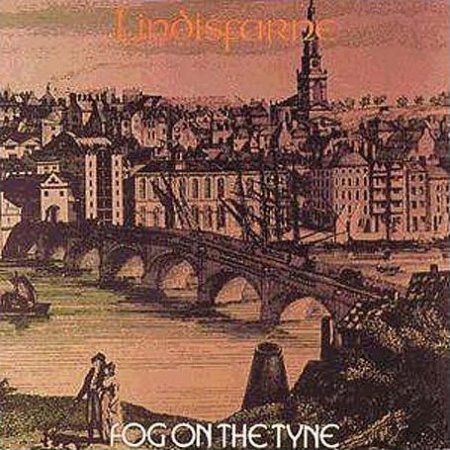
Lindisfarne and Europe 1972


Lindisfarne-FogOnTheTyne

“The fog on the Tyne is all mine,” sang Alan Hull. It was 1972 and Lindisfarne’s Fog on the Tyne was top of the UK album charts. This was the year Edward Heath’s government was preparing to take Britain into Europe for the first time. Naturally there was much argument. Pro-Europe Edward Heath managed to get a majority of his MPs to support him, though the Labour Party was opposed. This opposition led to the resignation of Labour’s deputy leader Roy Jenkins, who was in favour of supporting Heath’s efforts. The pro-Europe lobby managed to prevail through all this turmoil, and the European Communities Act was passed in October 1972. Britan entered the European Economic Community the following year.

Meanwhile Alan Hull was singing that the fog on the Tyne belonged to him. This of course was not meant to be taken seriously. The fog on the Tyne cannot really belong to anyone. But ironically, it is only something that belongs to no one in particular than can belong to everyone. With issues of nationalism and identity in the air, Alan Hull was making his statement about how a feeling of belonging can be combined with an open hearted view of the world. The Tyne was a place of trade, where different people came together to share what they have. Ships from overseas sit at the quayside on the charming album cover. It seems that people of all kinds might go there, and feel a sense that the Fog on the Tyne could belong to them.
From http://www.infobritain.co.uk

Festival of Britain

Festival_Of_Britain_Girls

From http://www.infobritain.co.uk

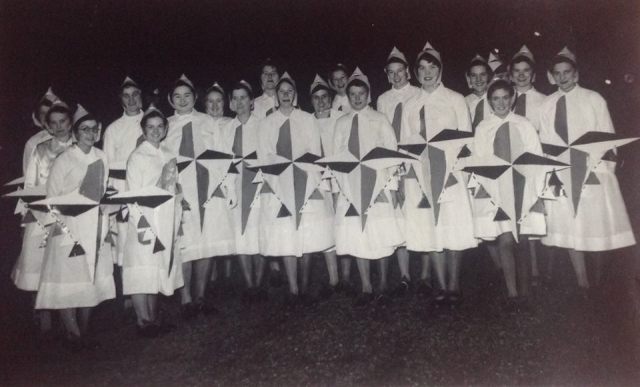
My mother-in-law shared a wonderful photo this week of a group of Kent girls dressed up to celebrate the Festival of Britain in 1951. This was a major event designed to celebrate Britain’s recovery from the Second World War. Sadly little of the Festival remains. With the exception of the Royal Festival Hall, the complex of buildings erected for the event on London’s South Bank has not survived. Unfortunately the Festival became a political issue. Organised by Clement Attlee’s post war Labour government, there was vigorous opposition from the Conservatives. Winston Churchill declared that the project was an expensive exercise in socialist propaganda. As soon as the Conservatives returned to power, in October of 1951, work started to demolish the Festival site. Today such an attitude seems incomprehensible. We have large-scale public events, the Millennium celebrations, or the London Olympics for example, which are not seen as socialist propaganda. You could make a point that perhaps today we have a greater acceptance of government organisation of life. But that’s not really accurate. There were massive public events in the nineteenth century, the Great Exhibition of 1851 for example, which left us the legacy of the museums in South Kensington. The truth is the Festival of Britain was a huge success enjoyed by many. There were ten million paid admissions over a period of five months. An incoming government did not like having a symbol of such success sitting in the middle of London. It had to go. But Jean’s photo is a small reminder of a great occasion.