The Timelessness of Neuromancer

neuromancer


Neuromancer is a genre defining book, written at a time when computer technology was about to change the way people lived.  1982 saw the standardisation of the Internet Protocols, which gave the potential for world wide proliferation of computer networks.  1983 saw the introduction of Apple’s Lisa, the first commercial personal computer to use a “graphical user interface”, the now familiar visual way of interacting with a computer using icons, menus and windows. Then in 1984, Ace Books published William Gibson’s Neuromancer, imagining a future where computer users can enter a shared “matrix” of linked data, which opens up in a visual way.

This is a historic book capturing an important moment in the development of world changing technology.  It is written in a visual style, like a comic in words.  However, this comic is a tough read, densely written with sudden jumps between scenes, often over the course of a short sentence.  These scenes can be in the real world, in the matrix world, or in a combination of both. It is impossible to skim read.  By the same token you also have to just let the writing open out in front of you.  If you want to know exactly what is going on at all times, this will be a frustrating book.

So is it a good book?  While Neuromancer may have captured a moment in history, when people began to interact widely and visually with computers, it is inevitably less successful in viewing the future.  There are so many anachronisms – pay phones, floppy discs, space stations with magazine stands and libraries of books.  Imagine a space ship full of glossy magazines and books straining into orbit when you can just send up weightless data to a screen.  The story involves data thefts – an idea which has a modern feel – but this involves hackers shutting down security systems in a physical building, so that people can get in there and steal a CD.

Sill, in making a judgement we should bear in mind that science fiction does not so much reveal the future as use a futuristic scenario to tell us about ourselves in the here and now.  That is where the real quality of Neuromancer lies.  The story portrays people with vast ambitions to develop human potential in partnership with computer technology.  But there is some wonderful, subtle imagery suggesting a kind of Buddhist stillness in this bewildering, violent, flashy, fast moving future.  For example, the magazine stocked space station, the setting for the story’s second half, contains a city built on the vast, curving inner surface of a hollow sphere.  There are two main roads in this city, a ring road called Rue de Jules Verne, and a road running across the length, called Desiderata.  If you go far enough around the Rue de Jules Verne, you will only ever come to Desiderata from one side or the other.

Desiderata is of course a prose poem written by Max Ehrmann in 1927. The tone of the poem is revealed by its opening sentence:

“Go placidly amid the noise and the haste, and remember what peace there may be in silence. As far as possible, without surrender, be on good terms with all persons.”

Go far enough around the science fiction circle of Jules Verne and you will only ever come back to the peace and acceptance of Desiderata.  This is the vision I found interesting, the stillness combined with all the disorienting action.  For me this nuanced view of human development constitutes the lasting quality of Neuromancer, allowing us to overlook details about pay phones and magazine stands in space.

Science Fiction – Back to the Future

drowned-world-jg-ballad

Some of the most successful science fiction has gone back to the past in imagining the future.  2001 a Space Odyssey starts in the earliest days of human history before catapulting out to a space station in Earth orbit.  Jurassic Park brings back dinosaurs. Then of course, there’s Back to the Future.

J.G Ballad’s story The Drowned World is an archetypal story of the future that includes a vision of the past.  The sun has become hotter, creating a flooded, tropical Earth.  The climate has returned to a state that prevailed during the Triassic period.  Human survivors of this watery apocalypse find themselves drifting back in dreams to an earlier incarnation of life on Earth.  Life has a buried memory of all that has gone before, and those buried memories begin to emerge during sleep.

This is a great premise for a story that can range from past to future.  I would also say that the idea has biological accuracy. I once read a book by the evolutionary theorist and writer Lynn Margullis tracing the echoes of ancient life in our own cells.  She points out, for example, that the salt balance of human tissue fluids mimics the salt balance of the ancient ocean from which life first emerged onto the land.  (See Microcosmos by Lynn Margullis for more.)

So this is a fascinating scenario for a book, which in many ways is poetically explored.  There are a few downsides, however. The dialogue between the characters can be that of “British schoolteachers hoisted out of the 1930s”, as Martin Amis puts it in an introduction.  The middle part of the story, centred on an evil looter, also becomes very conventional – the rescue of a damsel in distress trapped in the bad guy’s lair.  The damsel herself is vapid and lifeless, trying to hang on to the superficial cosmetics of her former self, even as she sinks into her Triassic dreams. All of the characters, for that matter, are somewhat two-dimensional.

Then again, Ballard is a clever writer who uses conventional structure while giving it a twist. The conventional part of the story coincides with people trying to hang onto a world that has gone – during a section when the evil looter drains part of flooded London.  In this way it’s as if the creaky old world emerges from the flood in hackneyed old plot devices. As for the characters, Will Self makes an interesting suggestion in an essay written for the reissue of The Drowned World in 2013.  Self writes that Ballard is not creating characters in the normal sense, with backstories designed to make us identify with them and read on. Instead, these are archetypes of people responding to change.  Some are vigorous in their resistance, wanting to hang onto what they know.  Others are accepting, waiting to see what the new situation will bring. The damsel in distress is a combination of these reactions. In that sense The Drowned World is more of a myth or a fairy story than a novel, despite aspects of the novel that are straight out of the Ian Fleming style of writing.

I don’t know if I buy this idea entirely, but I buy it enough to see that this is a fascinating book, interesting more for what lies beneath the water than for what floats on the top.


Voting for Boaty

boaty

Recently I read a book called The Populist Explosion which tried to explain to me why Europe and the United States have decided to vote in highly unusual ways.  Getting to the end, I wasn’t much the wiser.  Initially I thought it was all about the economically marginalised and the left-behind.  But then I learned that one of the most extreme populist movements in Europe can be found in Denmark, which has the world’s second most successful economy.  Similarly, the UK decided to leave the EU even though it had one of the strongest economies in Europe.

Then I read a BBC article called The Trump-Brexit Voter Revolt which told me that Trump was not particularly successful with voters on a low income.

So I have another theory.  This all started with TV shows where wannabe celebrities try to be pop stars, or where people who are already celebrities do horrible trials in the jungle, or learn to dance, ice skate or ski jump.  In all these shows, viewers vote to save the contestants they want to remain in the programme.  And in virtually all of these shows the audience has at one time or another decided it would be fun to vote for the most unlikely candidate, whether they are scared of spiders, have two left feet and no sense of rhythm, or can’t sing very well.   Two Scottish lads lasted long enough on the X Factor one year to get under the skin of the establishment, personified by Simon Cowell.  In 2008, John Sargent had to leave Strictly Come Dancing because he thought he might win.  John’s run of success dismayed the government of Strictly, led by PM Len Goodman.  This year the populist candidate on Strictly is none other than that former member of the establishment, Ed Balls.

The same populist pattern then crossed to the United States.  In the final of American Idol 2009, underdog Kris Allen beat the heavily favoured front runner Adam Lambert.  The writer Michael Prell tells me that over 50 million Americans voted for Kris.  Not many of them, however, went out and bought his record – only 0.16% of those 50 million decided they wanted his debut album.  It was the story of the underdog coming through that mattered, not how good that underdog was at singing.

This is where people realised how much fun it is to use votes to dismay the establishment.  It started with Pop Idol, veered off through votes to give crazy names to Antarctic research vessels, and ended up giving us Brexit, Corbyn and Trump.

It might not be so much fun now.


Designing the Future – From Lyons to Cupertino


design_museum

The Design Museum which reopens in November celebrates a process which is inextricably linked with the modern world. The period from 1770 to 1914 saw European society change profoundly. Industrialisation meant that craftsmen could no longer make spontaneous decisions about what they made. The actual creation of a product was increasingly mechanised, and a product’s form had to be worked out carefully beforehand, by someone who became known as a designer. This process began late in the eighteenth century, and is well illustrated by developments in textile production. In 1764 James Hargreaves invented the spinning jenny, a machine with sixteen spindles that greatly speeded up the spinning process. By 1769 this machine was being sold widely. Before any item was made using the spinning jenny it had to be planned, and then put into production.

But it wasn’t only technical planning that designers were responsible for. As they were designing the process to create a product, it occurred to many that planned changes to a product would help sales. From the 1760s the Lyons silk industry introduced twice yearly collections to enhance differentiation between products, to stimulate trade, and to combat copying. By 1800 patterns in printed cotton for dresses changed routinely with each season. For furniture fabrics new patterns were produced every two to three years.

apple_headquarters_in_cupertino

Apple Headquarters on Infinite Loop, Cupertino (Photo by Joe Ravi CC.BY.SA.3.0)

So designers created the technical ability of modern industry to produce products efficiently. They also created the idea of fashion that would keep people buying those products.  This process is exactly the same as the one applying now with something like the Apple iPhone.  The iPhone is upgraded annually, with a smaller upgrade within this cycle every six months.  These upgrades include both technical and aesthetic changes.  This design philosophy first emerged in the Lyons silk industry of the 1760s and has been travelling around an infinite loop ever since.


Yevgny Zamyatin -the Difference Between Literature and Propaganda


we-zamyatin


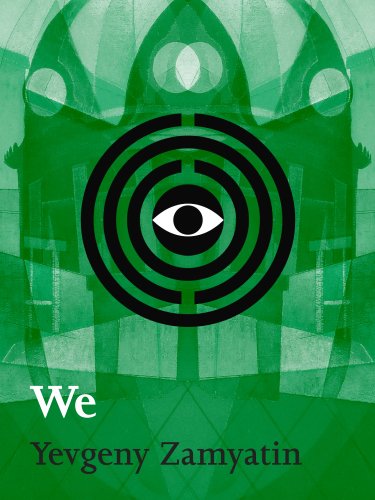
We by Yevgney Zamyatin is famous as founding the genre of dystopian science fiction.  Written in Russia between 1919 and 1921, the novel imagines a future society based on surveillance and control. Glass-walled apartments allow the state to keep an eye on everyone at all times.

I thought parts of the novel were wonderful. The best bits for me were the descriptions of an obsessive love affair, between the book’s protagonist – a highly-strung space ship engineer known as D503 – and a rebellious young woman, known as I-330, who drinks, smokes and talks revolution. D503’s love affair causes him to challenge assumptions that the state is all knowing and all good. He starts to feel like an individual. At the same time, he wants to lose his newfound identity in the beguiling eyes of his feisty girlfriend.

“Like a crystal I was dissolving in her, in I-330.”

The book is not simply a portrayal of an oppressive controlling state. This is a nuanced study of relationships, both personal and social. It has no clear messages to suit propagandists of any kind. D-503 likes maths, and realises that just as there is no final number in mathematics, so in life there is no final revolution. Life keeps going, with doubt and uncertainty keeping the wheels turning:

“Man is like a novel: up to the last page one does not know what the end will be. It would not be worth reading otherwise.”

I also liked Zamyatin’s quirky humour, not what you might expect from the father of dystopian novels. The manuscript of We is part of the story. As D-503 writes it, he describes various misadventures that affect his growing pile of paper. At one point, I-330 leaves her stockings lying on page 124 of the open manuscript. As well as making me chuckle, this also made the point that books really are just a pile of paper. No book, no philosophy, is the final word in wisdom. We is about discovering that such wisdom does not exist.

Unlike Ursula le Guin, I wouldn’t say this is the perfect science fiction novel. The plot is creaky in places, with sudden jumps that sometimes left me bewildered – particularly towards the end. Considering all that D-503 gets up to, the secret police seem rather absent, which was part of an occasional mismatch between actions and consequences.

Overall, however, this is a historic book, up there with the works of Jules Verne and H.G. Wells as one of the foundations of science fiction.

Ursula Le Guin and Brexit

left-hand-of-darkness-2

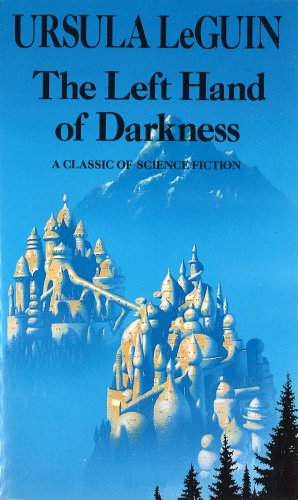
An envoy arrives on a rather backward planet called Winter.  His mission is to try to persuade Winter’s leaders to join a wider confederation of planets.  Blinkered nationalism, however, refuses to see the benefits of cooperation.  The envoy remarks sadly on his conversation with a stubborn king: “All I’ve told him means to him simply that his power is threatened, his kingdom is a dust mote in space, his kingship is a joke to men who rule a hundred worlds.”

Ursula Le Guin’s The Left Hand of Darkness is best known for its feminist theme, the inhabitants of Winter containing both female and male potential within one body.  But the book’s fascinating meditations are not confined to the relationships of men and women. Gender politics are part of wider duality informing religion and politics generally.  So wide ranging is the story’s scope that within a few paragraphs, this book published in 1969 was making me think of news I had read that day about Brexit and American elections. In an age of resurgent nationalism, The Left Hand of Darkness has much to tell us.

The minister Estraven could be giving advice to nationalists everywhere when he says: “No, I don’t mean love, when I say patriotism.  I mean fear.  The fear of the other.”


Goodwood as the Modern Country House Weekend

goodwood-circuit
Goodwood Motor Circuit


Did you know that the experience of staying at a hotel today is actually the re-imagining of an Edwardian country house weekend?  I had my own modern country house weekend at Goodwood recently.  Here’s how history conspired to give me my great few days:

If you were wealthy and well connected in the early twentieth century you might have received an invite to join Edward VII and his family at Sandringham.  Here a guest would enjoy luxurious accommodation, and begin their day with a strange meal, which we know now as the typical hotel breakfast…

“At Sandringham guests were expected to come down for breakfast between nine and ten o’clock. This was served at small tables, an innovative departure from the ‘long board’… Breakfast was a substantial meal; on the sideboard spirit lamps kept hot huge silver dishes of porridge, eggs, bacon, deviled kidneys, finian haddock, kedgeree. Another sideboard held a variety of cold meats, pressed beef, ham, tongue and game. China and Indian tea, coffee and chocolate, bread rolls, toast, scones and muffins, jams and preserves and fresh fruit were all laid ready.” (Bentley-Cranch Edward VII Image of an Era P 78).

After your breakfast, a program of various outdoor activities would start, usually hunting, riding and shooting in summer, and ice skating in winter.

With the aristocracy taking its lead from the king, other powerful families organised their own special weekends.  Then in a trickle-down effect, the fledgling hotel industry adopted and developed the format for a wider audience.  There have been some welcome changes to meet  modern tastes. Golf, for example, is a gentle evolution of hunting and shooting, with golfers walking through an idealised hunting park, taking their “shots”, hoping to bag a birdie, or even an eagle.  Today the loader offering a loaded gun to his master on a shoot at Sandringham has been replaced by a caddie offering golf clubs.

Echoes of Sandringham can be heard by any hotel guest, but they were particularly clear during my stay at Goodwood. There was the breakfast of course, which, if you stay at the Goodwood Hotel, you eat looking out at the golf course.  Then you might go off and and visit the famous horse race course.  Alternatively there’s the classic circuit for racing cars, the modern replacement of horses, the horse racing heritage seen in terms such as “paddock”.

I had a great few days enjoying an experience once confined to the few.


Dreaming of Electric Sheep

do-androids-dream-of-electric-sheep

When you read a book, if the author is any good, you feel for the characters living in its pages. A reader empathises with them, worries about them, and follows their story. Words on a page can create this real emotional attachment.

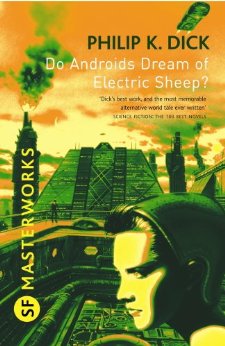
So if bits of the alphabet carefully strung into sentences can create living people, it’s not a big step to imagine androids who have a sense of life to them. This is the theme of Do Androids Dream of Electric Sheep? It describes a post-apocalyptic world where usually subservient androids occasionally go rogue and try to make an independent life for themselves. Bounty hunters have the job of hunting down renegades and putting them out of action. Their task is complicated by the fact that artificial life forms are growing in sophistication, looking and acting very much like real people. So a test is required to differentiate one from the other, a test based on the idea that humans demonstrate a capacity for empathy, which is missing in an android.

One of the great achievements of the book is to create believable artificial characters, robots with their own charm and personality. I loved the way one of the lady androids says “pardon” when confused, while her “husband” is a gauche fellow who always puts too much force into closing doors. They also have a kind of childish cruelty, giving a jagged edge to their charm. That was how the androids struck me, as children trying to work out how to live in the world. They lack empathy in the same way that young children sometimes lack empathy. But I got the feeling that given the chance, they might develop this quality, as most, if not all, humans do.

The overall irony is, human or android, all of Philip K. Dick’s characters are built out of words, and in that sense are equally fake and equally real. This is a book which encourages a reader to take a more open minded view of what is real and what is pretend, of what matters and what can be dismissed as unimportant.

Joining the Dots – History and Memory


memory_alison_winter

Alison Winter’s book Memory, Fragments of a Modern History.

I read this book for two reasons.  First, I am writing a character who has memory problems.  In his futuristic story, he has treatment with implants of data.  I wanted some background for that. Second, I am interested in history, which always seems in a process of constant rewriting to suit the needs of the present.  I wondered if there were any similarities with personal memory.

Well, for my character, I gained an understanding of how malleable memory is.  Clearly, there is already a science of memory manipulation, whether memories are implanted, boosted, or dampened down with drugs like propranolol. As for my question about history, influential writers such as Frederick Bartlett would say, yes, personal memory is like the broader memory of history.  There is a constant rewriting going on, changing our perspective on the past in light of later events.  A few days ago I happened to watch a video of Apple’s Steve Jobs giving a speech at a Stanford graduation ceremony.  He described various episodes in his life, which were painful or chaotic at the time, which he felt made sense later on.  He “joined the dots going backwards”. Personal memory and history both do this.  It is quite something to see the great shared memory of humanity working in the same way as you or me thinking about our pasts and trying to join our own dots.


Labour’s Long Search For Someone Like Jeremy Corbyn

palace_of_westminster


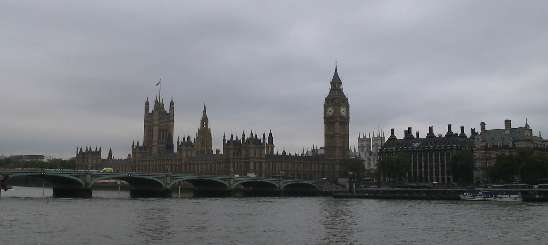
The history of the Labour Party could be seen as a continual search for someone like Jeremy Corbyn. The search began in the earliest days of the party, as a hunt for the first genuine Labour member of Parliament. For many years, two miners were pushed into this role – Alexander Macdonald, leader of the Lanarkshire miners, and John Burt, secretary of the Northumberland miners. These two men entered Parliament in the 1870s. Up until 1920, Alexander Macdonald – a remarkable man who even with the demands of a mining job gained a degree at Glasgow University – was named by Labour Party historians as “Britain’s first Labour member” (see The Book Of The Labour Party, ed H. Tracey Vol 32 P16). The problem, as time went on, was the willingness of Macdonald and Burt to enter into alliances with the Liberals to support their position, which eventually had historians ousting them as Labour Party founders.

With Macdonald and Burt no longer fitting the bill, Labour chroniclers looked for a different founding father. For a while they tended to settle on a miners’ union representative and journalist named Keir Hardie who entered Parliament in 1892. Hardie won his time as Labour’s apparent founder because, like Jeremy Corbyn, he was not a political animal at all. He refused to enter into the alliances his colleagues felt necessary. He stood alone as a party of one. If you can call one man the Labour Party, then Keir Hardie may have been its beginning. Inevitably, however, even the most enthusiastic historians realised that Hardie could not realistically be the creator of any party, because he simply was not a party man. Historians were then forced back into the world of fudge and compromise. Keir Hardie was quietly put to one side, and the 1906 election became the defining moment for Labour, when 29 Labour Representation Committee MPs were returned. The difficulty with this apparent breakthrough, was the fact that Labour still struggled to maintain distinctive independence from the Liberals. All Labour MPs were only elected because of local Liberal associations deciding not to put a candidate up against the Labour candidate and thereby splitting the non-Conservative vote. Labour, for all intents and purposes was still a wing of the Liberal Party.

So the search for a defining figure went on, continuing through the 1920s and early 1930s, when Labour actually had its first prime minister in James Ramsey MacDonald. Poor Ramsey MacDonald found himself in his first term in 1924 leading a minority government kept in power for ten turbulent months by an alliance with the Liberals. Things became even worse in 1931 when a short lived Labour government fell and MacDonald was forced into the leadership of a coalition which included the Conservatives! This accommodation of course did not fit with the vision of Labour purity, which left the first Labour prime minister – another remarkable man – a maligned figure for many in the party. So once more the endless quest continued, as it does to this day. In the end, however, it seems that the Labour party’s almost religiously inspired search for a divinely unsullied leader, does not have much to do with the reality of politics.