Dylan Thomas – Handing Over To Bob Dylan

Allen_Ginsberg_and_Bob_Dylan_by_Elsa_Dorfman

Bob Dylan with poet Allen Ginsberg in 1975

In my view Dylan Thomas was the last great poet. Until his death in 1953, poetry could be considered an influential part of culture. In the nineteenth century the poems of Tennyson, Byron, Shelley and Keats sold in huge quantities.  Byron in particular was treated almost as rock stars are today.  Byron even dressed rather like Jimi Hendrix. Into the early twentieth century, poetry continued to be a potent force, as seen in the work, for example, of the War Poets, W.B. Yeats, and T.S. Eliot. But from the 1950s onwards things changed. I like to think that the power of poetry survives and prospers, not so much in modern poetry itself, but through the huge influence of pop music where the rhythmic possibilities of words have been expressed in musical poems.

Dylan_Thomas_Study

Dylan Thomas’ writing shed at Laugharne

When I visited Dylan Thomas’ home at The Boathouse in Laugharne, I discovered to my surprise that Dylan Thomas did not make money from selling books, but from the sale of records, particularly in America. Following his death it was record sales that provided for his children, and for his wife Caitlin. Historically Dylan Thomas stood on a border line. He died in New York City on 9th November 1953. Only five months later, on 12th April 1954 Bill Haley and the Comets gathered in New York City’s Pythian Studios and recorded the Freedman/Myers track Rock Around the Clock. 

Rock Around the Clock, however, was not great poetry. This played on the mind of a young musician called Robert Zimmerman, who though he loved rock ‘n roll, found it lacking in lyrical sophistication. In 1959, at the University of Minnesota, Robert dropped the stage name Elston Gunn and started calling himself Bob Dylan, which is generally accepted as a nod towards Dylan Thomas.  This link is instructive. Bob Dylan took on the mantle of a poet. In notes to the album Biograph he says:

“There were great catch-phrases and driving pulse rhythms… but the songs weren’t serious or didn’t reflect life in a realistic way. I knew that when I got into folk music, it was more of a serious type of thing. The songs are filled with more despair, more sadness, more triumph, more faith in the supernatural, much deeper feelings.”

Via Bob Dylan’s interest in folk music, the serious ambitions of poetry found their way into pop music, which over the following decades was to see a great creative flowering.

In 2016 the Swedish Academy awarded Bob Dylan the Nobel Prize for literature.

The Hitchhiker’s Guide to the Galaxy

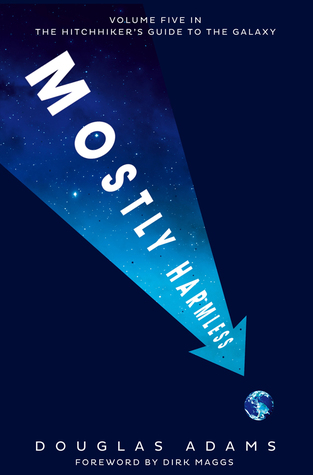
Hitchhikers Cover

I’ve been rereading some of the science fiction that I enjoyed at school, just to see how the future has treated it. The Hitchhiker’s Guide to the Galaxy made a huge impression on me in 1978. The original BBC radio shows were on late at night. I’d listen sitting on a dark gold velour sofa, in subdued 1970s light cast by a ridiculously tall, scarlet lamp decorated with amber flowers. I recorded each show, carefully pressing Record and Play together on a cassette deck. When the book came out at the end of 1979 I bought it immediately.

Feeling nervous thirty nine years later, I downloaded a copy of Hitchhiker’s to my iPad and started to read…

It was like meeting an old friend again; but it wasn’t all about nostalgia. At school, I just went for a ride. This time, as we flew along, I had a poke about in the book’s engines. It might seem presumptuous to claim knowledge of how those engines work, but I think it has something to do with exploiting quirks in the amusing contradictions of an infinite universe.

The nature of the Hitchhiker power is there at lift off, in the first chapter. Arthur Dent faces a local council official who has arrived with bulldozers to knock down Arthur’s house to make way for a by-pass. Immediately big and small things start mirroring each other. It is a big deal to Arthur Dent that the local council want to build a bypass through his house. Arthur’s predicament, however, is insignificant compared to the threat posed by unpleasant aliens called Vogons who are planning to build a hyperspace bypass through Earth. The threatened destruction of Earth seems a big deal, until, in turn, you remember how Earth is described as the book opens – an utterly insignificant blue-green planet in the backwaters of the unfashionable end of the Western Spiral Arm of the Galaxy. Against this background, you start to question the difference between big and small.

All of the humour and wisdom of Hitchhiker’s then spins out from this paradoxical colliding of opposites set up at the beginning. After the Vogons move their bulldozers through Earth, a rescued Arthur Dent tries to come to terms with what’s happened. He can’t feel the loss of Earth, since the event is just too overwhelming. The thing that really hits him is the loss of McDonald’s hamburgers.

Later in the book, for reasons I won’t go into, Arthur visits a chamber of hyperspace, thirteen light seconds across. This truly is a place revealing the odd nature of the scale of things.

“It wasn’t infiniy, in fact. Infinity itself looks flat and uninteresting. Looking up into the night sky is looking into infinity – distance is incomprehensible and therefore meaningless. The chamber into which the aircar emerged was anything but infinite, it was just very very very big, so big that it gave the impression of infinity far better than infinity.”

Ironically, with any immensity, a quality of smallness must be involved. This combination gives the sense of a long journey coming right back to where it started. I really enjoyed the comfort of that message. You could go back to sit on that velour sofa. At the same time you could take a typically 1970s kind of journey where you’re standing by a road sticking your thumb out, not entirely sure where you might end up. I once hitched in Scotland, and found myself dropped off in the middle of nowhere, north of Inverness. There was snow on the ground and doubt in my mind about whether I would get another lift before hypothermia set in. I took the advice on the cover of the Hitchhiker’s Guide – Don’t Panic. I might have been in the middle of nowhere, but relatively speaking I wasn’t really far from home. The Guide’s advice remains as relevant now as it ever was.

Book Burning in the Age of the Kindle

Fahrenheit 451

Fahrenheit 451, published in 1953, is Ray Bradbury’s famous depiction of a totalitarian future, where firemen, put out of work by flameproofed houses, are reassigned by a repressive government to the task of burning books. Books with their tendency to make people think and question, are seen as a threat. They are destroyed while people get on with consuming a diet of what appears to be endless soap opera playing on wall-sized television screens.

After first reading Fahrenheit 451 in paperback at school, I thought I’d see how it was doing in the age of the Kindle.  My reluctant conclusion is, not well, certainly in the predictive sense. Bradbury imagined a future where culture becomes monolithic, with everyone consuming the same lowest common denominator TV drivel. In reality, culture is much more fragmented than it was. Rather than a tool of uniformity as portrayed in Fahrenheit 451, information technology increasingly allows people to pick and choose. Television viewing with its fixed schedules and limited channels has fallen steadily – a 10% drop in the UK between 2012 and 2016, according to the Reuters Institute. People are increasingly finding their own cultural niche, via all kinds of on-demand services, video streaming and social media. This has caused its own problems, which are the opposite of the problems Bradbury envisaged. America, for example, where Fahrenheit 451 is set, has seen increased polarisation between people holding opposing political beliefs. During his time as President, Barack Obama noted that the choices offered by modern media allowed people to more easily shut away things that challenged a particular world view. He encouraged people to try and find a way outside their bubbles.

So the book’s look into the future has not exactly played out.

Reading the Kindle edition of Fahrenheit 451 has been an odd experience.  Reading a book about the malign effects of technology on books, using technology which makes it easier to read books, was disconcerting.  Having a think afterwards, it seems to me that maybe lots of people who are now in influential positions in America recall Fahrenheit 451 from their youth.  A lot of them operate in a country so programmed to fear totalitarian government that the population has free access to guns which they use to shoot each other regularly.  Those left alive vote incompetent people into government who don’t actually believe in government, since their version of totalitarism is personal rather than institutional. In Bradbury’s book, we only learn the President’s name, but he is a faceless prescence.  There is no sense that institutions can actually defend us from the vagaries of individuals.  Perhaps once-young people who run things in the 2020s should read Fahrenheit 451 again, just to remind themselves how different the real problems we face are from the ones we thought we would have to face when the book was written.


Things Fall Apart

ThingsFallApart 3

The first English novels, appearing in the Eighteenth Century, were heavily influenced by an earlier tradition of Christian morality tract. This sense of teaching some kind of moral lesson has remained a characteristic feature of novels ever since. Of course, in the world of the secular novel, morality generally becomes a difficult thing, very different from the simple portrayal of appropriate reward and punishment for various types of behaviour.

Things Fall Apart is an interesting twist on this, written in English by African author Chinua Achebe, portraying a culture far removed from that of England. The book describes the life of a man called Okonkwo, who struggles to reach the heights of his traditional tribal society in late nineteenth century Nigeria. His rise up the greasy pole is made difficult, both by the arcane rules of his own society, and by those of English missionaries, who arrive in Nigeria. In the Nigerian culture, morality is hugely important. However, the details of what is considered right and wrong are profoundly different to that of Victorian England. In this story of a collision of values, we learn that the instinct to define correct behaviour is deeply ingrained in people the world over. Actual rights and wrongs, however, are virtually arbitrary. People could be considered bad, and win praise for it; or they can be deemed good, yet fall foul of the law through no fault of their own.

Reading about Okonkwo’s life, I couldn’t help thinking of Oscar Wilde, living in London at about the same time, facing a society which defined homosexuality as a crime beyond any other. One day that worst of all crimes would not be a crime at all. In writing about this kind of impermanence of right and wrong, Oscar Wilde could also be summing up Things Fall Apart:

“A man cannot always be estimated by what he does. He may keep the law, and yet be worthless. He may break the law, and yet be fine. He may be bad, without ever doing anything bad. He may commit a sin against society, and yet realise through that sin his true perfection.”

Settling Old Scores With The Invisible Man

Invisible Man

If I could, I would use H.G. Wells’ time machine to go back to a particular day at Warwick University during the autumn of 1983.  I was sitting in a student kitchen listening to a science post-grad telling me, a humble first year English student, that he was pursuing worthwhile work researching a cure for the common cold.  He further informed me that courses in literature were a waste of time and money.  Stepping out of my time machine, I would produce a copy of The Invisible Man and push it across the table to Mr Cold Cure.  I would tell him that this is a tale of a scientist named Griffin who makes himself invisible.  Griffin is an arrogant man who thinks that normal limits do not apply to him. His story shows that arrogance in science is the same as arrogance anywhere.  As well as turning him into a monster, this arrogance also makes him a bad scientist.  Scientific work pushes back the boundaries of human knowledge, but the careful business of seeing things often involves helpful limits to our vision.  Take the example of X-rays, which pass through skin, but are only useful in showing the details of bones because they cannot pass through bone.  The Invisible Man has found a way to take away all appearances and reveal what lies beneath.  But take away too many appearances and there’s nothing left.  Consider the eyes we use to see things.  They are only able to see anything at all because the retina absorbs light.  Notice how the retina is the last thing to resist Griffin’s invisibility experiments.  If the retina becomes transparent, letting light through, we would lose the power of sight.  A real transparent retina would not work, and symbolically the retina makes a last stand against the scientist, against his arrogant confidence that he can see everything.

Notice also, I would declare, warming to my subject, that the Invisible Man, puffed up with his achievement of invisibility, finds himself living amongst simple Sussex folk in the village of Iping. Griffin, the great scientist, might feel himself superior to innkeepers, farmers, village Bobbies and students of literature, but seeing too much is the same as not seeing anything at all.

Keep the book, I would say. And, oh, by the way, where I come from in your middle-aged future, the common cold is as common as ever.  Then I would step back into my time machine and return to the present day.

Words and Music

Grease

Articles about music might seem out of place on a blog about writing, but words and music have always gone together. In pre-literate societies, if people needed to remember words, they tended to put them together in rhyming or rhythmic patterns, making them easier to recall. It was only a short step to using different pitches of the voice, and sound made by external means to further enhance those verbal patterns.

When written language came along, the link with music continued. Western music derives its basic shape from the Greeks, particularly from fifth century BC thinker Pythagoras. Greek musicians decided on the distances between musical steps, which generally speaking are still in use today. They also confirmed the relationship between words and music by naming musical notes after letters of the alphabet.

With the collapse of the Greek civilisation, the alphabetical system of musical notation was lost for centuries. Music survived largely in Gregorian chant, a combination of words and music designed to help illiterate Medieval congregations remember passages from the Bible. The time came, however, when musicians once again required notation to represent music. After both Pope Gregory the Great, and Emperor Charlemagne demanded a standardisation of chants, it became politically vital for church choristers to reproduce chants in an accepted way. This demanded notation.  From the 7th Century, marks called neumes, began to appear, indicating where the voice should go up or down. But these marks did not indicate where a singer was starting from on the ladder of musical sounds.

The breakthrough came when a teacher of choristers at Areazzo, named Guido Monaco, came up with a notation system to help orientate his pupils as they struggled to learn hundreds of chants. Described in his books Aliae Regulae and Micologus, both published around 1030, Monaco’s system took its lead from the Greek idea of turning to the written word, naming notes after letters of the alphabet – A,B,C,D,E,F,G. He drew a red line above a line of words to be sung, a line which Monaco declared represented middle F, a note right in the centre of a singer’s normal singing range. Then a second yellow line was added to represent middle C. Other notes could then be written above or below these two lines at graduated heights. It was now possible for a singer or musician to know exactly which note they had to sing or play. It was also possible to read and write music. Until this point music had been an oral tradition with no specific composers, but with Monaco’s system it was possible for people to start writing down musical ideas. The first named composer is generally held to be a Frenchman named Perokin, who lived roughly between 1170 and 1236. He wrote his music as you might write a story, using Monaco’s system based on the letters of the alphabet.

Today the link between words and music is if anything stronger than ever, in the various forms of song writing which have dominated global culture since the 1950s.

Hans Christian Anderson said that where words fail, music speaks. You could also say that where words and music come from is actually the same place.

Grease 2

The Fundamentalist Within

Reluctant_Fundamentalist

The Reluctant Fundamentalist is a one sided conversation between a Pakistani professor named Changez, and an unnamed American, taking place mostly in a street café in Lahore. Changez describes an education at Princeton, a subsequent short career at one of New York’s top business consultancies, a love affair with a beautiful American girl, and his eventual disillusion with the United States. All of this happens around the time of the 9/11 attacks on the World Trade Centre and Washington.

The conversation is enigmatic. Changez is a delightful host, unfailingly polite and obliging to the suspicious, surly American, who, we infer, is clearly worried that this whole conversation is some kind of set up. Is he imagining these threats? Is he ruining a lovely meal with a charming man due to some kind of delusion?

These is much delusion in this book. We see characters who classify fundamentalism as an insane state of mind confined to a few crazy religious people who come from somewhere vaguely east. Changez’s story, however, makes it clear that there are all kinds of fundamentalism, ranging from the business philosophy of New York consultancy firms, to the idealised love affairs of vulnerable young women. Confining the idea of fundamentalism to one set of circumstances and people is a fundamental misunderstanding.

The result of this misunderstanding is a kind of paranoid delusion. Just as Changez’s American dining companion imagines an attentive waiter as a possible assassin, America itself became delusional about terrorism after 9/11. The 9/11 attacks led to the deaths of 2990 people, which it goes without saying was a terrible thing. From 2001 until 2013 there were a further 390 American deaths from terrorism, almost all of them overseas. This compares to 406,496 deaths from American firearms in the same period – according to figures from the Centers for Disease Control and Prevention at the U.S. State Department. Deaths caused by Americans shooting themselves and each other, are 100 times greater than those resulting from terrorism. Yet it is the terrorist threat that Americans fear, while their own far more lethal guns and attitudes are expressions of “freedom”. The aim is always to find an outside threat, some other people to count as crazy fundamentalists. Changez tries to explain this to his guest:

“As a society… you retreated into myths of your own difference, assumptions of your own superiority.”

This trend is only gathering force. CNN compiled the above comparison figures for terrorist and American gun related deaths in 2015. They did so at the encouragement of President Obama, following a mass shooting at an Oregon college. In 2016, millions of Americans decided it was a good idea to replace President Obama with a man who is only interested in creating outside threats against which he can rage.

All of these delusions sit behind the fictional, enigmatic meal shared by Changez and his American guest. Is this a peaceful meal or an attempted assassination? If the American’s suspicions are misplaced, might those suspicions themselves result in real trouble? Similarly, Pakistani fears could themselves lead to a violent outcome. Is the American reaching into his pocket for a phone or a gun? Is it wise to wait and find out? This might only be fiction writing, but this is a good place to explore the dangerous power of fictions as they collide with the real world.

The Reluctant Fundamentalist reminds me how important books are. This book is even more significant now than it was when first published in 2007. Books challenge stagnant patterns of thought and open up different points of view. Perhaps that’s why totalitarian leaders don’t like them.

The Artist Formerly Known As…

Love_Symbol_Album_(Prince_and_the_New_Power_Generation_album_-_cover_art)

I have been writing about band names lately.  Maybe now we come to the point where names reach their limit.

Naming sets boundaries. This has a practical purpose in classifying and organising. A group of musicians, for example, need to identify themselves on posters, on listings for Apple Music and Spotify. But some musicians have, nevertheless, tried to escape the limits of a name.  There have been non-names, such as The Band, or The The. Prince went a step further and tried to identify himself with an unpronouncable symbol.

Although, fortunately, most musicians don’t go as far as Prince, there is a characteristic desire for musicians to identify themselves with ambiguous names, which try to escape easy classification. Let’s finish with some names that tried to be vague enough to include us all. Culture Club had a gay Irish vocalist, a black London-born bass player, a blonde English guitar and keyboard player, and a Jewish drummer. This band included all kinds of people representing all kinds of cultures. Culture Club, however, remains a name. Even a group of different cultures has an identity from which some will want to escape.  A Culture Club, inclusive though it is, probably wouldn’t be a comfortable place for the people who seek the apparent security of one culture – as perhaps the culture club of the EU is finding to its cost. The Human League has a similar irony, a league including all humans, except those who don’t want to be lumped with all other humans.

Culture Club

A name is always going to have limits. You can’t escape that, not even by adopting an unpronounceable symbol: you’re just given an unwieldy name that begins The Artist Formerly Known As… Since escaping names is impossible, the only real option is to find a good one, which suggests both identity and something bigger than identity. You could become Procol Harum, which seems to mean something but actually doesn’t mean anything. Alternatively, there’s Pink Floyd, The Who, Mott the Hoople, or Aztec Camera.  You could choose Blur – is that a word referring to something moving fast, or a non-word denoting boredom?  Alternatiely, there’s Oasis, which in suggesting a few trees, also suggests a much bigger desert.

So, what have band names taught us?  That have shown that people have an instinct to name, to limit, even something as amorphous as music.  They have also shown that names truly catching the imagination are those that try to escape identity through enigma and ambiguity.

So whether you’re headed to Heaven 17, or taking a lift to Level 42, or going on a Snow Patrol, or booking tickets for a Show of Hands, a good name suggests some other place to go when you get there.  Hope you’ve enjoyed the trip.


T. Rex – Abbreviated Rock

Trexmetalguru

Exploring language via band names.  This week – T. Rex.

Between 1967 and 1969, Marc Bolan led a psychedelic folk group called Tyrannosaurus Rex, which didn’t do very well.  In 1970 Bolan moved to an electric sound, and modified the band’s name slightly. T. Rex went on to become one of the most influential forces in 1970s rock.

T. Rex was a better name than Tyrannosaurus Rex. Let’s have a think about why that should be.  T. Rex is an abbreviation, where letters are missed at the end of a word. Abbreviations can also take the form of contractions, omitting letters from the middle of a word, as in Mr; or an acronym, where different words are formed into a single set of letters, as in USA. All these reductions of language have the same sort of effect. They concentrate long, complex ideas into something short and pithy; or bring diverse things together into one whole.  They also tend to create a sense of excluding outsiders – taking the form of a simple code, there’s a suggestion of secrecy, belonging, exclusivity and power.  It’s no surprise that many countries have been identified by abbreviations – USA, UAE, USSR, GDR, UK, DPRK.  It’s also no surprise that abbreviations are popular with the military, in management speak and in the titles of academia.  Ironically, there can also be an informality associated with shortened language, as any experienced Twitter user would know.  But the basic rule of differentiating a group still applies.  The most casual of Twitterspeak serves the same purpose as the most clipped of military acronyms.

Bands that use abbreviations in their names tap into all of this. There are many examples – AC/DC, R.E.M., ABBA, REO Speedwagon, Booker T and the M.G’s, Guns N’ Roses, INXS, CSNY, OMD, ELO, 10cc, U2, JLS, AWOLNATION. The power of the abbreviation effect is illustrated by the fact that removing one letter can make all the difference.  Led Zeppelin dropped a single a. The Lovin’ Spoonful dropped a single g.

Acdc_logo_band.svg

The AC/DC logo designed in 1977 by Gerard Huerta (Image attribution)

Such is the attraction of elision that sometimes band names not intended as real abbreviations have been treated as such by imaginative fans, or by suspicious moral guardians.  KISS was not an acronym, but that didn’t stop people finding Kids in Satan’s Service hiding in those four letters.  The heavy metal band W.A.S.P. only put full stops between the letters of their name because they thought it looked cool.  They left interpretation of their meaning to both their fans and detractors.

So there you have it – T. Rex has a louder roar than Tyrannosaurus Rex.  That’s the power of abbreviation as illustrated by band names.

The Comedy of Errors

img_0604

Watching The Comedy of Errors,  Battle Abbey,  East Sussex

Last night, in the grounds of Battle Abbey, I saw the wonderful Lord Chamberlain’s Men performing Shakespeare’s The Comedy of Errors.  It was great fun, two pairs of twins getting into all kinds of confusion. It might seem wrong to analyse such carefree entertainment, but as the dusk drew in, and a creamy moon rose over the action of a hectic day in Ephesus, the effect was so striking that not to give this play some thought seemed disrespectful.

So there I sat in my fold-up chair, pondering on this lovely play while doves cooed from hidden perches in abbey stonework.

The play opens with the arrest of elderly Syracusan trader, Egeon, following the discovery of his unauthorised presence in Ephesus.  Syracuse and Ephesus are at war, and strict law forbids Syracusan merchants from entering the city of their rivals.  Egeon can only escape a sentence of death by paying a fine of a thousand marks. He then tells his tragic tale to Duke Solinus who sits in judgement on the unfortunate man’s case.  In his youth, Egeon explains, he and his wife had twin sons, both called Antipholus. On the day of their birth, a poor woman lacking the means to raise children, also gave birth to twin boys, both called Dromio. Egeon purchased these boys as slaves to his sons. Soon afterwards, the family made a sea voyage, which was hit by a storm. Egeon lashed himself to the main-mast with one son and one slave, while his wife lashed herself to a separate mast with the other son and slave. His wife was rescued by one boat, Egeon by another, which resulted in the boys and their slaves living separate lives in Syracuse and Ephesus.  When the Syracuse Antipholus reached adulthood, he decided to set out with his Dromio on a quest to find their twins. When they did not return, Egeon went in search of them, a search which eventually brought him to Ephesus where he now sits at the mercy of the Duke’s judgement.  The Duke is so moved by Egeon’s story that he grants him one day to find someone in the city who can help pay his fine. Though this seems like a lost cause, Egeon is unaware that Syracuse Antipholus, pursuing his quest,  has just arrived in Ephesus.  That’s when the fun begins as the brothers are mistaken for each other by various citizens of the city.

For some reason, as I watched all this, an odd detail from the world of biology popped into my mind, the fact that the most intense competition in nature takes place between similar organisms, as they compete for the same niche. Antipholus of Ephesus and Antipholus of Syracuse are identical, but their cities are at war.  All of the confusion of the play is due to the twins’ similarity rather than their differences. This was an interesting thought on a peaceful summer evening. The world seems particularly divided at the moment, but at the end of the play as confusion is resolved and brothers are reunited, the essential similarity underlying division came to the fore.

I to the world am like a drop of water

That in the ocean seeks another drop